I arrived at the event without prior preparation. I had zero experience with Open Mercato, I hadn’t written a single line of TypeScript, and I had no pre-defined project idea. Despite this, within 36 hours, we built a fully functional system that manages service tickets from the initial customer contact to field technician scheduling.
The most fascinating part wasn't just shipping the product, but the velocity with which we entered a completely foreign environment and started building production-grade logic.
Hackathon Open Mercato. Engineering without prior stack knowledge
The first surprise was how quickly the barriers fell. In a well-architected, AI-first environment equipped with the right tooling, a lack of specific stack knowledge is no longer a blocker.
Instead of catching up on theory, I focused on immediate execution. In a hackathon setting, understanding everything from minute one is secondary to the ability to rapidly test, iterate, and verify what works.
From the start, AI tools played a pivotal role. They helped me bootstrap the environment, inspect the core, and accompanied me through every subsequent step. Codex provided premium accounts to ensure we wouldn't run out of tokens. And yet, we did! This perfectly illustrates the scale of AI integration in this project – it wasn't a "nice-to-have" feature; it was our primary workstation.
A tight deadline and a clear objective force decisive action. There is no room for overthinking; practical verification often outpaces documentation.
Open Mercato. Accelerating application Development
My first impression of Open Mercato? I wasn't fighting the framework.
I was handed a sensible foundation. Features that usually require building from scratch were already available. Yet, the platform didn't feel like a "black box" that restricts you to a rigid model. If something didn't fit, it was easily extendable. Even when I had to touch the core logic – which happened once – it was a seamless process.
In a hackathon context, this is mission-critical. Instead of wasting time on the plumbing, we could immediately dive into the business logic and focus on delivering actual value.
Perhaps years of working with Sylius conditioned me to this methodology: the framework provides 80%, and you customize the remaining 20% for the specific use case. It’s not a classic "top-down" approach where the tool dictates your workflow. Rather, you get a set of high-quality building blocks to construct exactly what you need.
Service Management System. An Open Mercato Mini Case Study
We chose the "showcase" track, where our PoC, "Open Serwis" began to take shape hour by hour.
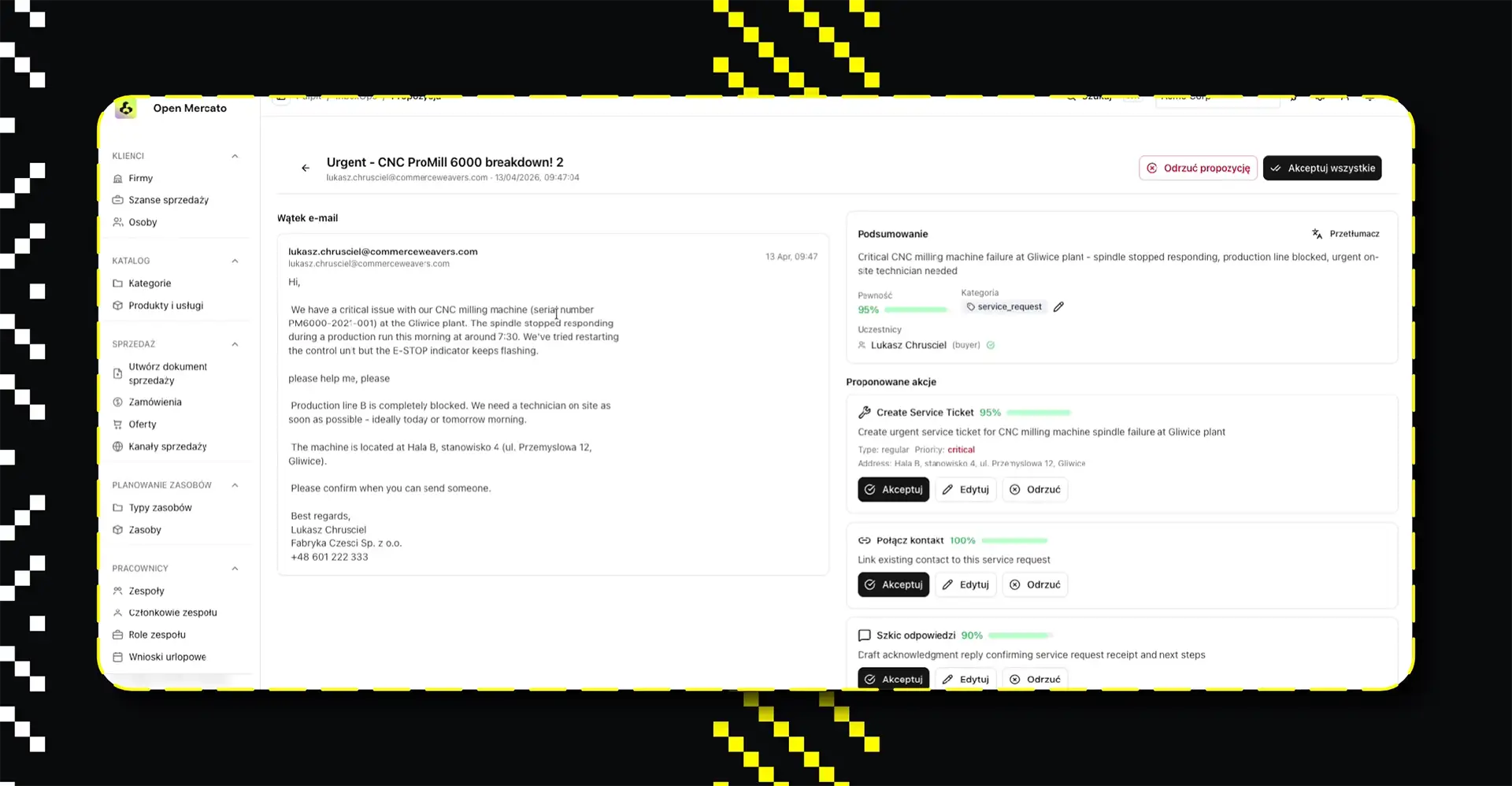
In practice, it was an end-to-end service management system – from the moment a customer calls or emails to the field service scheduling.
Automated Processing. The system ingested tickets from various channels and processed them instantly. AI extracted key data points – identifying the defect, location, context, and priority – then transformed them into structured records. No manual data entry, no guesswork.
Operational Planning. Based on these records, operators could plan the workflow: matching skills to tasks, checking availability, estimating travel time, and calculating costs.
Integrated Logistics. We mapped routes and estimated mileage, all unified within a single interface.
The best part? It actually worked.
Development was heavily augmented by AI: Codex, Claude, multiple terminals, and parallel processes. Throughout the entire hackathon, I didn’t even open an IDE. Code was generated, modified, and iterated on the fly. My role was to provide direction, make architectural decisions, and verify the output.
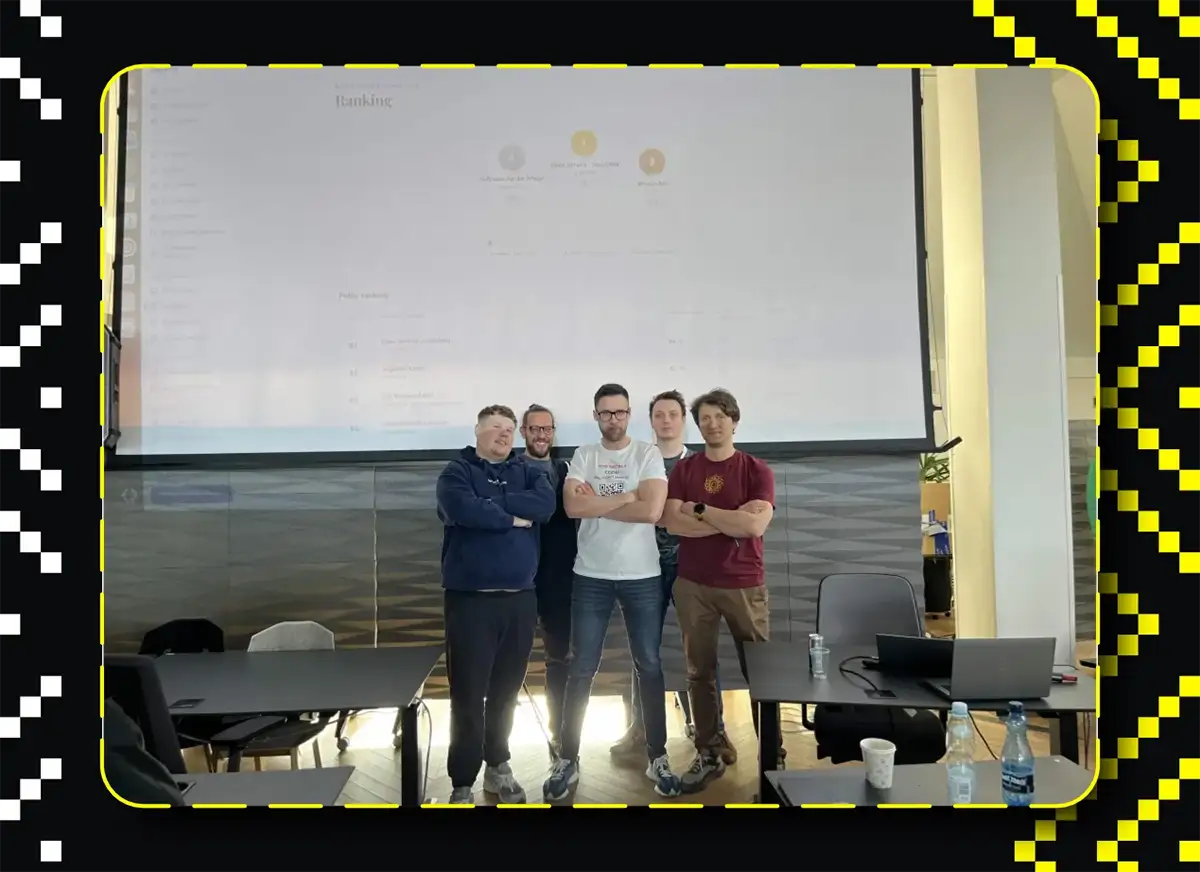
A project of this scale isn't a solo endeavor. I joined a team of people I hadn’t met before, yet we achieved instant synergy. It was one of those rare moments where a group of strangers functions like a long-term engineering unit within hours.
The presence of business specialists who truly understood the "what" and "why" was invaluable. In an AI-first world, the "how" is becoming a commodity. The real value lies in knowing exactly what is worth building and why.
Special thanks to Jarek, Robert, Dawid, and Bartek from Itrix, as well as Łukasz from Hycom – for the shared effort and an impressive final result.
Lessons from the Hackathon. Engineering in a new paradigm
The main takeaway? Open Mercato has significant potential.
It is lightweight, flexible, and can be launched locally in no time. For me, it’s particularly interesting how well it conceptually complements the technologies I use daily. There is a clear potential for building complementary solutions for projects that require more than a "turnkey" box.
Secondly, entering a new technology doesn’t have to be a painful process. The friction of unfamiliar syntax or environmental basics can be largely neutralized by AI. What remains are the classic engineering challenges – solution quality, sound architecture, and solid design decisions. These are the constants we know from every other implementation.
Finally, while Open Mercato is a young product evolving before our eyes (the hackathon alone generated over 200 core contributions), this is its strength. Being at this stage allows for real influence and co-creating its direction. For clients ready to adopt early, this means a level of velocity and flexibility that mature, closed tools simply cannot match.
FAQ – Open Mercato
What is Open Mercato?
It is a platform for building business applications that provides a robust foundation while remaining fully extensible for project-specific requirements.
What makes Open Mercato stand out?
It bridges the gap between ready-made components and full customizability. You don't start from zero, but you aren't locked into a pre-defined solution either.
Can you build an application without prior stack knowledge?
Yes, provided you have an environment that doesn't obstruct development and you focus on iterative building rather than exhaustive preparation.
How does AI support application development?
It accelerates repetitive tasks – from boilerplate generation to rapid prototyping and idea verification. This allows for faster iterations and the ability to test multiple architectural approaches in a short timeframe.