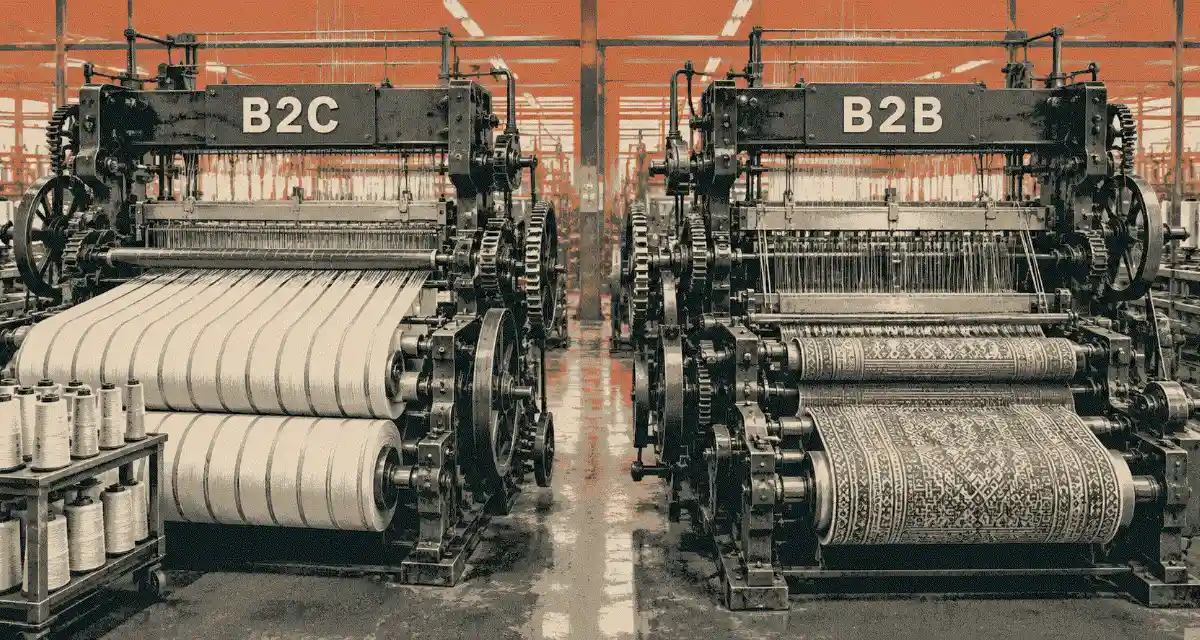
One Platform for B2B and B2C or Two? How to Design E-commerce Architecture for a Growing Business
More and more manufacturers, distributors and commerce companies are developing B2B and B2C sales in parallel. Business customers expect self-service purchasing platforms, individual commercial terms and integrations with enterprise systems. Consumers, on the other hand, expect fast purchasing, an intuitive interface and a consistent experience across devices. This leads to a natural question: should you develop one B2B and B2C platform or build two independent systems?
It is one of the most important architectural decisions in e-commerce development. It affects not only implementation costs, but also the pace of product development, team organization, the number of integrations, maintenance costs and the ability to scale the business over the coming years.
The problem is that this discussion often starts in the wrong place.
Companies compare technologies, licenses and features before answering a more fundamental question: how should their business actually operate?
The decision between one B2B and B2C platform and two separate solutions is therefore not simply about choosing an online store. It is a decision about the architecture of the entire sales ecosystem.
In this article, we explain how to approach this decision from the perspective of business processes, organizational structure and long-term company growth. We look at when a shared platform makes sense, when separating the two channels may be the better option, and which questions should be answered before the project begins.
One B2B and B2C Platform or Two Separate Systems? Key Takeaways
Question
Answer
Can one platform support both B2B and B2C?
Yes, provided that the architecture reflects the organization's business processes.
Does B2B e-commerce always require a separate platform?
No. Many companies successfully develop B2B and B2C sales within a shared ecosystem.
Does one B2B and B2C store mean one system?
Not always. A shared platform may use a common backend, data or integrations while keeping the user experiences separate.
What should determine the architecture?
Business processes, organizational structure and the company's growth strategy, rather than technology alone.
Does one platform always reduce costs?
No. A shared architecture can simplify the technology landscape while also increasing development and maintenance complexity.
What Is a B2B and B2C E-commerce Platform?
The term B2B and B2C e-commerce platform is often used very broadly, even though in practice it can describe very different architectural models.
For one organization, it may mean a single online store serving both business customers and consumers. For another, it may mean a shared backend with two separate user interfaces.
There are also architectures in which both channels use the same product data and integrations with systems such as ERP or PIM, while their purchasing processes remain completely independent.
Before deciding whether a single B2B and B2C store is the right solution, it is therefore worth answering a different question: what exactly should be shared?
This may include:
product catalog,
availability information,
inventory data,
integrations with ERP, PIM or CRM,
administration panel,
product management logic.
At the same time, many elements can be designed independently, including:
purchasing process,
pricing policy,
user authentication,
order workflows,
payment methods,
user interface.
This means the decision is not simply a choice between one or two online stores. In reality, you are designing an architecture that defines which components are shared and which are developed independently.
Why Do B2B and B2C E-commerce Have Different Requirements?
Although B2B e-commerce and B2C sales use similar technologies, they address very different customer needs.
A B2C platform focuses primarily on purchase speed, user convenience, marketing activities and conversion optimization.
A B2B platform, on the other hand, supports more complex business processes. These may include customer-specific pricing, multiple users within a single account, credit limits, order approvals and integrations with systems used by business customers.
The differences are just as visible on the payments side – one of the areas where the two models diverge the most. We covered them in detail in our comparison of B2B and B2C payment terms.
This does not mean that the two models always require separate platforms.
In many organizations, products, inventory data, integrations and content management remain shared, while purchasing processes and sales logic differ.
In Discovery projects, we almost never start by asking whether a client needs one platform or two. First, we analyze sales processes, organizational structure, data sources and the direction in which the company plans to grow. Only then do we assess which architectural components should be shared and which should remain independent. This ensures that the platform decision follows business requirements rather than assumptions made before the analysis begins.
Step 1. Start with the Organization and Its Processes, Not the Technology
The most common mistake happens before the project even begins.
Teams compare e-commerce platforms, analyze licensing models and prepare feature lists before defining how the organization actually operates.
Instead, the architectural decision should begin by answering the following questions:
Do B2B and B2C customers purchase the same product range?
How different are their purchasing processes?
Do both channels support the same business objectives?
Are both channels developed by the same teams?
Which data should be shared?
How does the company plan to develop its sales operations over the next three to five years?
The answers to these questions determine whether a shared B2B and B2C platform will support the organization's growth or gradually become a source of unnecessary complexity.
Step 2. Decide Which Platform Components Should Be Shared
One of the most common mistakes is treating this decision as a choice between one system and two systems.
In practice, a modern B2B and B2C e-commerce platform consists of multiple components that can be developed either together or independently. Instead of asking whether to build a single online store, it is worth considering which elements genuinely need to be shared.
A well-designed architecture makes it possible to share data and integrations where this creates real business value, while preserving the freedom to develop processes that differ between B2B and B2C sales independently.
This approach provides greater flexibility than treating the entire platform as a single, indivisible system.
Which Components Are Usually Worth Sharing?
In many organizations, the greatest value comes from sharing data and the components responsible for managing the product offering and integrations with other systems.
Area
Why is it worth sharing?
Product catalog
A single data model eliminates information duplication and simplifies product offering management.
Inventory
Both channels use the same information about product availability.
ERP integrations
A single integration point simplifies data exchange and reduces maintenance costs.
CRM
A shared customer database makes it easier to analyze customer relationships and sales activities. However, it is important to note that B2C and B2B customers are often completely separate groups.
Administration panel
A single management system reduces the number of tools used by the team.
Sharing these components can reduce the number of integrations, simplify data management and lower the risk of inconsistencies between sales channels.
Which Components Usually Require More Independence?
This is where the most significant differences between B2B and B2C sales emerge.
The purchasing process for a business customer usually involves considerably more stages than a consumer purchase. It may include individual commercial terms, order approvals, multiple users within a single account and integration with the company's procurement processes.
For this reason, the following areas are most often developed independently:
Area
Why is it worth separating?
Pricing
Business customers use individual price lists, discounts and commercial terms.
Order process and checkout
B2B often requires additional steps such as order approvals or deferred payments. Order fulfillment is usually more complex than in consumer sales.
User accounts
Organizations use multiple users, roles and permission levels.
Promotions and marketing
Mechanisms designed for individual consumers are not always applicable to B2B sales.
User interface
Business buyers and consumers have different goals and expectations of the purchasing process.
This does not mean that each of these areas requires a separate system. In many cases, a properly designed architecture is enough to allow individual components to evolve independently.
There Are More Than Two E-commerce Architecture Models
Discussions about B2B and B2C platforms are often reduced to two extreme scenarios: one shared system or two completely independent platforms.
In practice, some organizations choose an architecture somewhere in between.
Model 1. One Platform
All B2B and B2C sales operate within a single system.
This model works particularly well when:
both channels use the same or a very similar product catalog,
purchasing processes differ only slightly,
one team is responsible for developing both channels,
the organization wants to limit the number of systems and integrations.
The biggest advantage is simpler technology landscape management and greater data consistency.
Model 2. Shared Backend, Different Purchasing Experiences
This is currently one of the most compelling architectural models.
Products, integrations and data remain shared, while B2B and B2C customers use separate user interfaces and different purchasing processes.
This approach maintains architectural consistency while providing greater freedom to develop each channel independently.
For many growing organizations, it offers a compromise between simpler maintenance and business flexibility.
This approach is primarily chosen by companies where B2B and B2C sales operate almost as two separate businesses.
This usually means:
different product teams,
different growth strategies,
independent roadmaps,
completely different business processes.
This model gives each channel greater freedom to evolve, but it also means more integrations, higher maintenance costs and the need to synchronize data between platforms.
B2C sales often change very dynamically. New marketing campaigns, user interface changes, A/B tests and seasonal promotions mean that the platform is developed almost continuously.
B2B e-commerce usually evolves differently. Changes happen less frequently, but they tend to involve more complex business processes, integrations with enterprise systems, automation or the way business customers are served.
If both channels use the same platform, the architecture should allow each of them to evolve without changes in one channel blocking development in the other.
This is why, when designing the technology landscape, it is important to consider not only the organization's current requirements, but also how both channels are likely to evolve over the next three to five years.
One of the most common mistakes is designing the platform exclusively around the organization's current needs.
At the beginning, the differences between B2B and B2C sales may appear relatively small. As the company grows, however, new sales channels, additional markets, more integrations and increasingly complex business processes begin to emerge.
The architectural decision should therefore reflect not only the organization's current situation, but also the direction in which the business is expected to develop.
Commerce Weavers Architecture Decision Framework
There is no universal answer to whether it is better to develop one B2B and B2C platform or two independent systems.
The decision can, however, be structured.
Area
One platform is likely to be a good choice when...
Greater separation is worth considering when...
Product offering
Both channels sell the same or a very similar product range.
The product offering differs significantly.
Purchasing process
Most stages are shared.
Each channel requires its own workflow.
Pricing policy
Differences can be handled through configuration.
Pricing models are completely different.
Organization
One product team is responsible for development.
B2B and B2C have independent teams and roadmaps.
Pace of change
Both channels evolve at a similar pace.
One channel requires significantly more frequent changes.
Integrations
Most systems can be shared.
The channels require different integrations.
Strategy
The organization develops both channels together.
Each channel follows a separate business strategy.
This is not a checklist to complete mechanically. Its purpose is to show that the architectural decision should result from an analysis of the entire organization, rather than from a comparison of e-commerce platform features alone.
If the answers fall on both sides of the table, do not guess – validate the option with a proof of concept before committing the budget for a full implementation.
How Can You Tell That the Current Architecture Is No Longer Working?
Even a well-designed platform can stop meeting the organization's needs over time. Sometimes this is not caused by limitations in the technology itself, but by changes taking place within the business.
It is worth reassessing the architecture when:
development in one channel regularly blocks changes in the other,
the backlog continues to grow and delivery times for new functionality increase,
every change requires modifications across multiple components,
platform maintenance is becoming increasingly expensive,
the number of exceptions and custom configurations continues to grow,
data synchronization or integration problems are becoming more frequent,
product teams increasingly compete for the same resources.
Most of these signals point to growing technical debt rather than to the platform split itself. Before deciding to separate the systems, it is worth running a quality and performance audit to show where the bottleneck really lies.
Warning signs do not automatically mean that the platform needs to be split. They are, however, a clear signal that the current architecture needs to be adapted to the organization's new requirements. In the most difficult cases, we take over and stabilize implementations at risk.
Does One Platform Always Mean Lower Costs?
This is one of the most common misconceptions. A shared B2B and B2C platform can reduce the number of systems, simplify integrations and lower the cost of administering the technology landscape.
However, this does not automatically mean lower development costs. The more business processes are placed within a single system, the more complex that system becomes. Every change then requires consideration of more dependencies, more extensive testing and greater coordination between teams.
On the other hand, maintaining two completely independent platforms also creates additional costs. The organization needs to develop and maintain two environments, support additional integrations and ensure data consistency between them. Cost analysis should therefore not be limited to comparing the number of platforms.
What matters much more is understanding the cost of architectural complexity and the cost of evolving that architecture over time.
Yes, if both channels share a significant proportion of their data, products and business processes. In many organizations, a shared platform simplifies technology landscape management and reduces the number of integrations.
Should a B2B Platform Always be Separated from B2C?
No. In many cases, it is sufficient to separate selected processes, such as pricing, checkout or user account management, while keeping data and integrations shared.
What Should B2B and B2C Channels Share?
The greatest benefits usually come from sharing the product catalog, inventory data, ERP, PIM and CRM integrations, and the administration panel.
When Should You Consider Two Independent Systems?
Primarily when B2B and B2C sales operate as two separate businesses, with their own teams, independent roadmaps and significantly different sales processes.
Is Architecture a Permanent Decision?
No. Many organizations start with one platform and gradually separate additional components or processes as the business grows. A well-designed architecture should support this kind of evolution without requiring the entire technology landscape to be rebuilt.
Want to Verify Which Architecture Is Right for Your Organization?
If you are planning to develop B2B sales, B2C sales or both channels in parallel, it is worth starting with an analysis of business processes and architecture before selecting the technology. During Discovery projects, we help organizations determine which platform components should be shared, where independence should be preserved and how to design an architecture that will continue to support business growth in the years ahead.