In B2B, failure is rarely just about UX. When a deployment stalls, "adding another sprint" is a fallacy. Success requires identifying the root cause and that is where our expertise becomes mission-critical.
What is B2B Project Rescue?
At its core, Project Rescue in B2B e-commerce is the takeover and systematic stabilization of a project that is no longer delivering business value. We step in when systems suffer from recurring regressions, unstable infrastructure, skyrocketing maintenance costs, or "frozen" development due to high architectural entropy.
The Anatomy of a B2B E-commerce Crisis
A crisis rarely happens overnight. It usually begins with a "feature-first" mindset: rushing complex implementations like tiered pricing, corporate accounts, or custom checkout flows. Under pressure, architectural integrity is sacrificed for speed, and integrations are built to handle only the "happy path", failing to scale as business complexity grows.
The system may appear stable until the business tries to scale - adding new customer segments or modifying price lists. At this point, the tight coupling between modules causes simple changes to trigger unforeseen regressions across the entire platform.
Symptoms of a Failing B2B E-commerce Project
In most cases, the issue isn't a lack of "manpower," but a loss of control over system fundamentals and a "fragile" codebase where every fix introduces new bugs.
Step-by-Step B2B Project Rescue Process
A well-executed project rescue does not start with a decision to rebuild the entire platform. First, we must establish what actually works, where the highest risks lie, and which system elements can continue to be developed without generating further regressions.
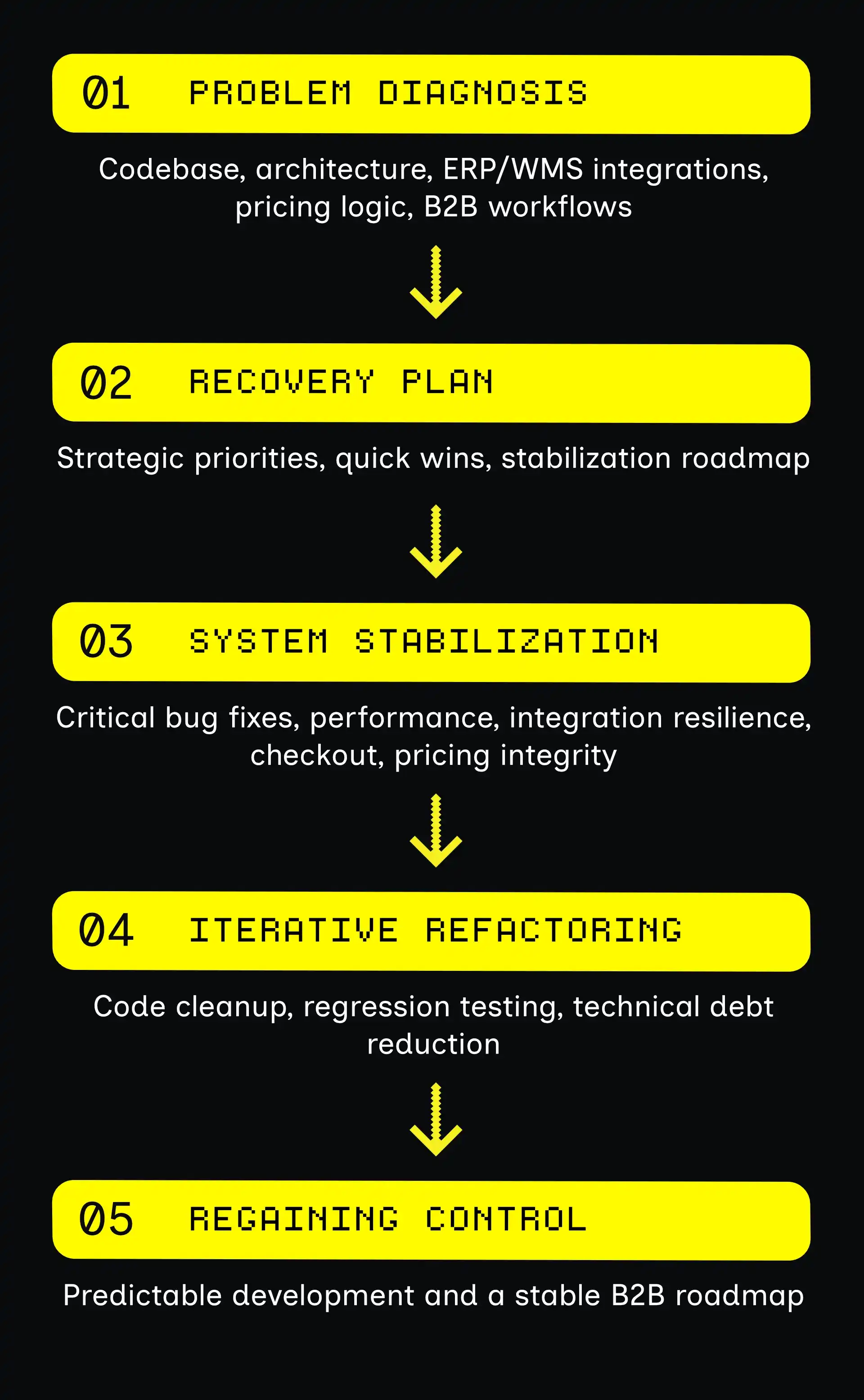
1. Diagnostic Phase. Audit of Systems, Integrations, and B2B Processes
The first step is a comprehensive audit: a diagnosis of the source code, architecture, integrations, infrastructure (including databases), test coverage, and business processes. In B2B e-commerce, it is mission-critical to verify the pricing logic, ERP integrations, inventory synchronization, order workflows, and user roles on the client side. The objective is not to assign blame, but to determine precisely why the system lost its predictability.
2. Recovery Plan and Quick Wins
Following the diagnosis, we develop a recovery plan. In B2B projects, we often operate on two parallel tracks: stabilizing the most critical areas immediately while simultaneously building a realistic roadmap for systematic cleanup. Quick wins might include stabilizing the ERP integration, optimizing checkout performance, securing pricing logic, or implementing essential regression tests for key purchase scenarios.
3. Iterative Refactoring and Regaining Architectural Control
In most cases, it is impossible to fix an entire platform with a single "big bang" release. It is far more effective to perform iterative code cleanup, reduce technical debt, and gradually rebuild trust in the system. In a B2B environment, it is vital that these efforts do not halt sales or disrupt customer service. Project rescue must restore stability without paralyzing daily operations.
4. Regaining Control Over the B2B E-commerce Roadmap
The ultimate value of a project rescue is the return to predictable development. When integrations are stable, pricing is under control, and the engineering team no longer fears deployments, the conversation can finally return to new features, sales automation, and scaling the platform. The system stops being an operational risk and starts supporting business growth once again.
Does B2B Project Rescue imply a complete rebuild?
No. A project rescue does not have to mean building the platform from scratch. In practice, one of the most significant values of this process is precisely separating the elements that require a complete overhaul from those that can still be safely developed.
In B2B e-commerce projects, a full rebuild often seems tempting, especially when the team is exhausted by system instability. However, rebuilding the entire platform carries its own set of risks: repeating the same architectural mistakes that led to the rescue in the first place, complex data migrations, recreating integrations from scratch, securing operational processes, and maintaining sales continuity. Therefore, the decision to "rewrite from scratch" should always be the result of a rigorous audit, not a reaction to frustration.
Sometimes, the optimal path is the refactoring of selected modules; other times, it involves rebuilding a critical segment, such as the pricing engine, checkout flow, or ERP synchronization. A full rebuild only makes sense when maintaining the current architecture generates higher risks and costs than a controlled restart. Project Rescue helps define that boundary and allows for a decision based on objective facts, rather than emotions.
Read: 5 situations where Sylius outperforms off-the-shelf e-commerce platforms.
When should you initiate a B2B E-commerce Project Rescue?
The ideal window for intervention usually arrives much earlier than most organizations anticipate. If development velocity is visibly decelerating, integrations are prone to failure, maintenance overhead is escalating, and the engineering team develops a "fear of change," these are clear indicators that technical entropy will continue to worsen.
In B2B e-commerce, bugs in areas that directly impact revenue streams are particularly hazardous. This includes pricing engines, product availability, credit limits, approval workflows, ERP synchronization, and order fulfillment. When these mission-critical components perform unpredictably, the platform ceases to be a growth engine and instead becomes a significant operational risk.
Explore our case studies.
FAQ – B2B E-commerce Project Rescue
What defines B2B Project Rescue?
It is a structured process of auditing, stabilizing, and taking over a platform that has lost its technical and business predictability.
When does a B2B platform require a rescue?
When development velocity stalls, ERP/WMS integrations become unreliable, pricing logic fails, and maintenance costs exceed the value of new features.
Does a rescue require a total rewrite?
Rarely. Often, stabilizing the architecture, refactoring critical modules, and introducing a robust testing suite is sufficient to regain control.
What is the most common blocker in B2B development?
Legacy integrations, technical debt, inconsistent pricing logic, and a lack of regression testing are the primary contributors to system fragility.
Is it possible to take over a project from another vendor?
Yes. Most of our rescue missions involve taking over legacy systems, performing an architectural audit, and stabilizing the environment without interrupting the client's sales operations.