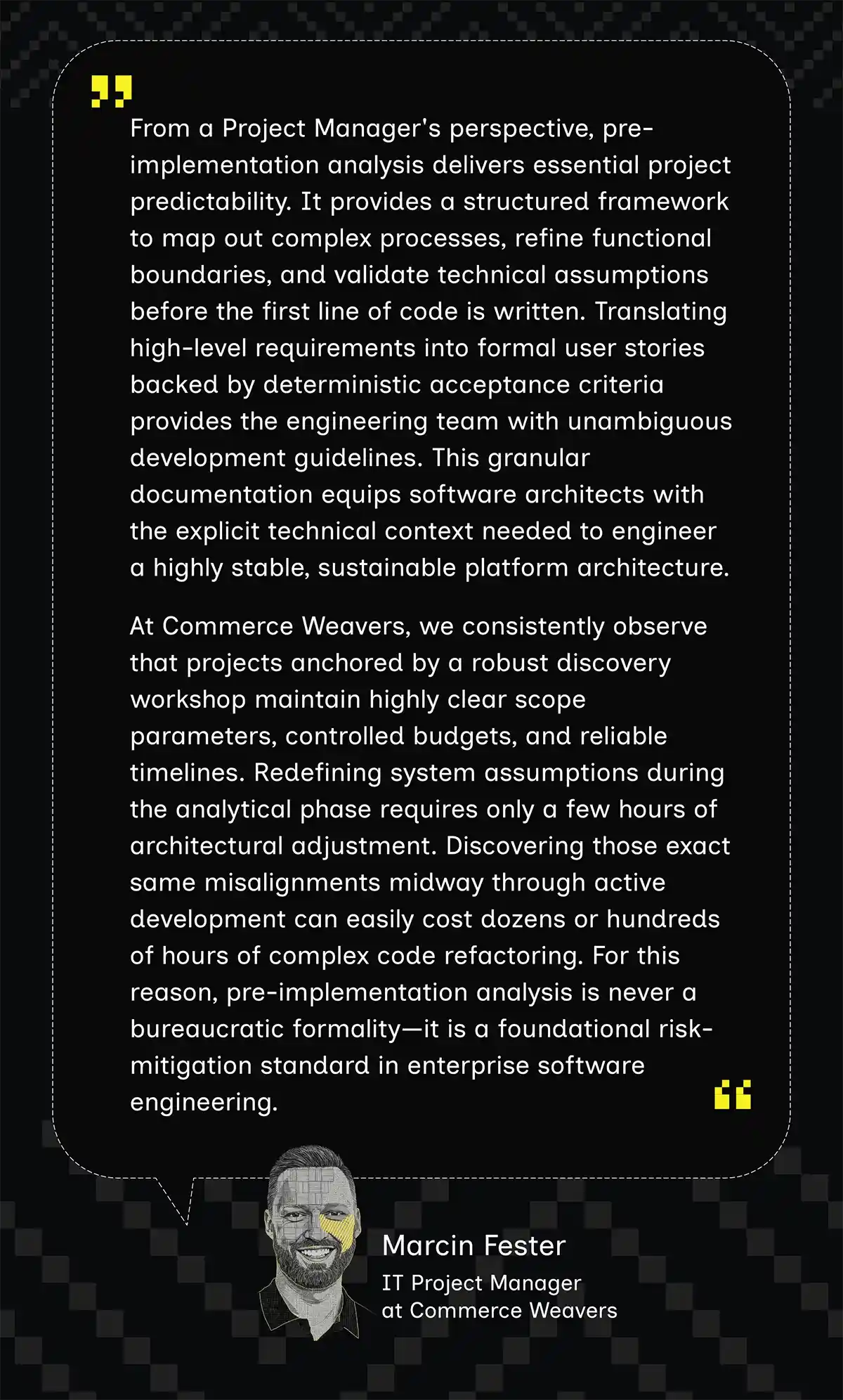
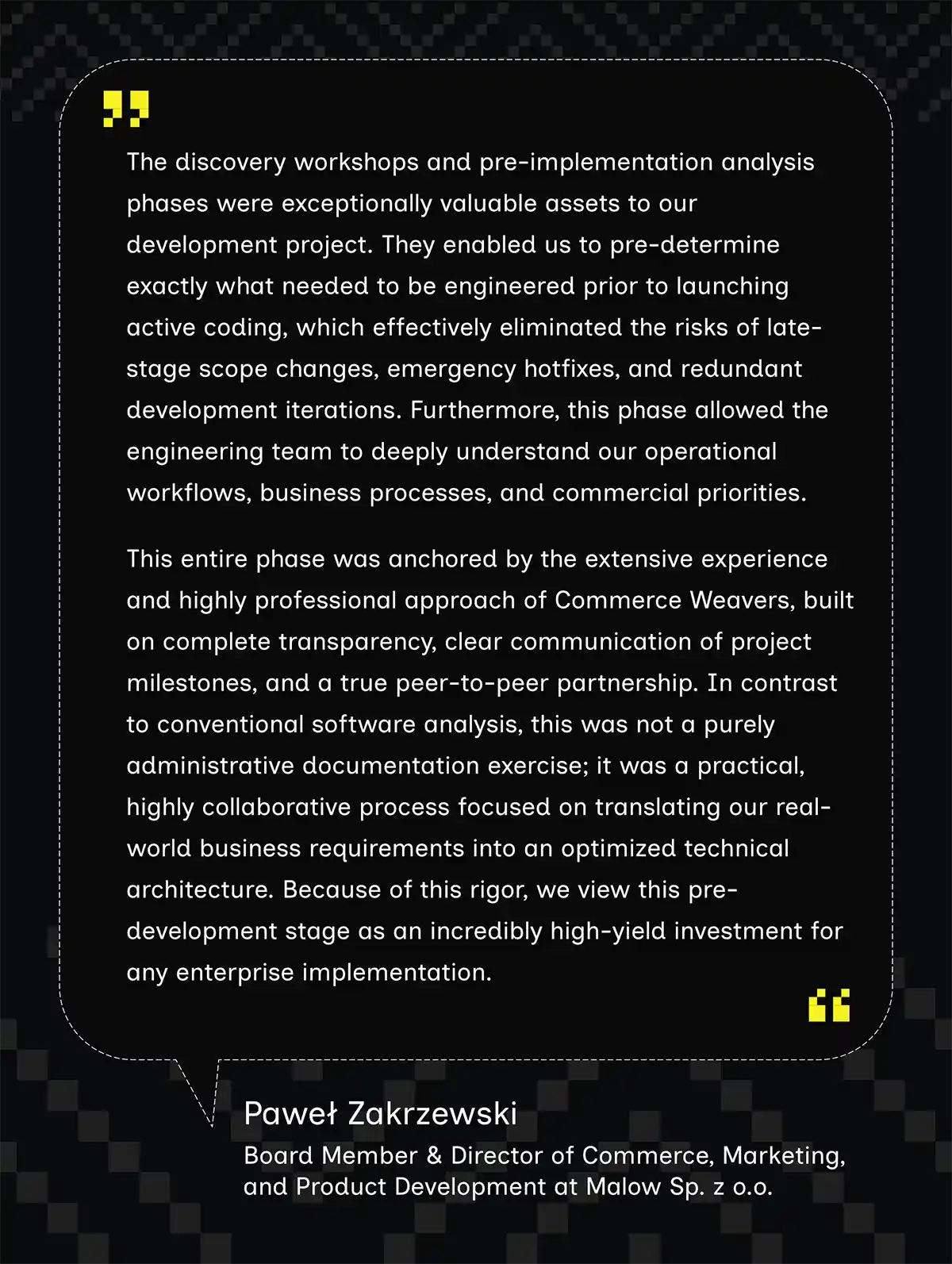
This phase must not be mistaken for a high-level "strategic meeting" dominated by vague slideshow presentations and generalized operational advice. A rigorously executed pre-development workshop for B2B e-commerce implementations must deliver deterministic, highly technical outcomes:
Comprehensive mapping of complex domain and business logic dependencies
Early identification and isolation of systemic technical risks
Structural analysis and ordering of complex system integrations
Formal definition of the target platform and database architecture
Accurate, data-driven estimation of total project costs and functional scope
In enterprise engineering, this analytical stage single-handedly dictates whether the platform will scale predictably along its planned roadmap, or begin accumulating architectural entropy, compounding technical debt, and continuous delivery delays within the first few development cycles.
What is a Discovery Workshop in Enterprise E-commerce?
A discovery workshop is an intensive analytical phase executed prior to the development kickoff, designed to audit project requirements, establish data governance, and secure the foundational technical decisions of the application.
Within B2B ecosystems, this initial discovery process extends far beyond the customer-facing storefront presentation layer. It must encompass the entire multi-tenant operational and transactional architecture:
ERP,
PIM,
WMS,
pricing,
order workflow,
commercial processes,
integrations,
user roles,
logistics,
and data architecture.
This deep scoping is mandatory because the dominant share of B2B e-commerce friction does not stem from a lack of standard features. It is caused by an architectural mismatch between off-the-shelf framework mechanics and the company’s actual operational processes.
Consequently, a professional discovery workshop must never conclude with merely a superficial list of functional requirements. Its core objective is to analyze exactly how the enterprise operates under load, identifying which software components constitute the critical path for scalable business growth.
Why Pre-Development Scoping is Paramount for Modern Architectures
Historically, many legacy e-commerce deployments bypassed structured analytical scoping, moving almost immediately into active coding phases. Functional scope was outlined parallel to feature development, and long-term architectural decisions were determined ad hoc as engineers built out the code layer. For less complex implementations – particularly lightweight, monolithic B2C websites handling standardized consumer checkout flows – this unguided implementation model occasionally sufficed.
But this lack of structure breaks down entirely when an enterprise project introduces non-linear B2B transaction flows. In these environments, failing to map out the application architecture early introduces massive structural overhead.
Without a unified business and technical blueprint, the engineering team is forced to make low-level development choices in isolation. Integrations are wired up via short-sighted architectural shortcuts, and newly introduced features continuously override or break the underlying logic of previous sprints. While the organization may observe rapid initial storefront progress, development velocity drops sharply after a few months. The project roadmap turns unpredictable, and introducing any new functional iteration demands a ballooning amount of engineering refactoring.
A technical discovery workshop acts as a preventive engineering gate.
Structural Anatomy of a B2B E-commerce Discovery Workshop
A high-value discovery workshop does not consist of compiling arbitrary feature requests into a product backlog, nor does it focus on drafting rigid specification documents that drift out of sync with the application code within weeks. The explicit goal is to build a shared, technically accurate understanding of business workflows, application architecture, and platform constraints across stakeholders and engineers prior to development.
In practice, a professional discovery architecture evaluates three core operational pillars:
1. Business Process Modeling and Domain Mapping
The initial phase focuses on deconstructing the precise operational mechanics of the enterprise. This requires auditing and mapping key transactional workflows:
B2B buyer journeys and complex procurement flows.
Hierarchical corporate account structures and user permission tiers.
Algorithmic contract-based pricing engines and volume discount rules.
Complex warehouse fulfillment and logistics streams.
Order management lifecycles and historical order tracking.
Structural dependencies and intersection data flows across these distinct domains.
In many legacy enterprises, these business processes exist solely as undocumented institutional knowledge or within fragmented procedural logs. The discovery workshop extracts, standardizes, and translates these operational requirements into explicit system architecture designs.
2. Architecture and Integration Analysis
The second phase executes an in-depth audit of the enterprise’s existing technology ecosystem.
An enterprise B2B e-commerce platform rarely operates as an isolated monolith; it functions as a component within a complex constellation of enterprise software, including ERPs, PIMs, CRMs, WMSs, payment gateways, shipping APIs, and BI platforms. Because of this interconnectedness, integration interfaces represent the most technically critical risk zone of the entire deployment.
During this architectural scoping, engineers must definitively answer critical integration questions:
Which external application serves as the authoritative single source of truth for each specific data domain?
What are the explicit data synchronization mechanisms?
Which system integrations reside on the critical transactional path?
Where are the primary system bottlenecks and single points of failure?
Which specific data flows demand asynchronous processing models to decouple system dependencies and protect platform availability?
This analytical stage frequently exposes latent architectural flaws that would otherwise halt down-the-line platform development. It is common to find existing legacy integrations configured without explicit data ownership definitions or engineered without considering data scaling requirements. As a result, the interconnected systems function correctly only under baseline operational parameters; any significant spike in transactional load or schema adjustment causes a cascade of data synchronization failures across the architecture.
Therefore, evaluating integration layers during a discovery workshop cannot be limited to compiling a generic checklist of system connections. It must map data lineage, quantify operational bottlenecks, and identify high-risk integration touchpoints to secure long-term system stability.
3. Systematic Technical Risk Mitigation
A professional discovery workshop must explicitly identify and isolate the highest-risk vectors within the project scope. Depending on the enterprise, these risks often center on complex B2B pricing calculators, legacy ERP interface constraints, custom multi-vendor marketplace logic, or catalog performance overhead under heavy SKU strain.
The goal is not to eliminate every single technical risk during the workshop itself, but rather to establish an explicit risk profile:
Defining exactly which system dependencies require immediate technical validation.
Isolating high-risk components that must be validated via an immediate Proof of Concept (POC).
Quantifying where architectural changes will introduce the highest cost penalties downstream.
By establishing these risk vectors early, the discovery workshop provides the direct technical blueprint for targeted, downstream Proof of Concept engineering.
Intersecting the Discovery Workshop with a Proof of Concept
While discovery workshops and Proof of Concept (POC) phases are deeply connected, they represent entirely separate lifecycles within software engineering. A discovery workshop audits, structures, and documents project requirements, business processes, and system architectures. A Proof of Concept goes a step further, validating explicit technical hypotheses and integration assumptions by executing functional code inside an isolated, working sandbox environment.
If your organization has completed initial scoping and needs to validate core technical features or evaluate implementation timelines for a specialized POC or Minimum Viable Product (MVP), you can leverage our structured delivery models, such as our accelerated fixed-price PoC / MVP in 3 months program.
To read more about the underlying mechanics of validation architecture, read our full article on: What is a Proof of Concept.
Preparing Engineering Teams for Enterprise Delivery
The outputs of a technical discovery workshop are not limited to business stakeholders and software architects; they serve as an essential onboarding mechanism for the core engineering team.
By running a structured discovery process, software engineers gain a comprehensive understanding of the platform specifications prior to sprint planning:
The underlying corporate domain and business model.
The critical path workflows across the application lifecycle.
The transactional integration logic and data transformation boundaries.
The system-wide architectural constraints and infrastructure limitations.
The core development priorities and delivery milestones.
Providing engineers with this architectural foundation eliminates the severe risk of building core software components isolated from real-world operational context. In complex B2B e-commerce deployments, this structural clarity makes a massive impact. An engineering team that thoroughly understands the underlying operational processes of the enterprise makes significantly better local design decisions, adheres closer to SOLID principles, and avoids introducing accidental technical debt into the codebase.
The optimal time to execute a discovery workshop is at the absolute inception of the digital transformation lifecycle – prior to scheduling code sprints or assigning development teams.
Pre-development discovery delivers the highest return on investment under specific project conditions:
The architecture requires deep bidirectional integrations with enterprise ERP, PIM, or WMS platforms.
The organization is executing a complex platform migration from a legacy system to a modern architecture.
The deployment involves transitioning toward multi-channel or omnichannel commercial operations.
The business model dictates complex, highly customized B2B pricing calculators and custom authorization rules.
The development roadmap has stalled due to conflicting feature priorities or unstructured requirements.
The enterprise needs to isolate and mitigate long-term systemic architectural risks.
Furthermore, running an intensive discovery workshop is highly effective when an active, production platform has ceased to scale or develop predictably. In these recovery scenarios, the discovery process operates as the primary phase of a project rescue lifecycle, enabling architects to map out technical debt and regain control over system architecture.
Critical Failure Modes in Discovery Implementations
The most severe mistake an enterprise can make is treating a discovery workshop as a generic "requirements gathering" exercise. In practice, a discovery phase must prioritize analyzing business logic, uncovering technical risks, and mapping integration architectures, rather than simply compiling an unvetted backlog of storefront features.
Another common failure mode is excluding operational, logistics, and ERP system administrators from the workshop sessions. Within B2B e-commerce architectures, the vast majority of critical transactional events occur entirely behind the storefront presentation layer. Failing to ingest the technical realities of back-office operators inevitably leads to deeply flawed architectural assumptions during early code design.
Organizations also frequently miscalculate the sheer complexity of integration analysis. Poorly mapped data pipelines and uncoordinated synchronization schedules remain the primary drivers of runtime performance degradation, database race conditions, and platform instability after deployment.
Finally, a discovery workshop must never be viewed as a process that terminates solely in static documentation. The true value of an analytical discovery phase lies in establishing definitive technical choices, locking down integration interfaces, and preparing the organization for a structured, predictable development lifecycle.
Workshops are also highly valuable when the current platform ceases to develop predictably. In such scenarios, discovery can serve as the primary phase of a project rescue lifecycle and help regain control over the system architecture.
FAQ – e-commerce discovery workshop
What is a discovery workshop in e-commerce?
A discovery workshop functions as a structural element of the pre-implementation analysis, spanning the deep architectural auditing of business processes, application foundations, and data integrations prior to core development phases.
What are the benefits of a discovery workshop?
The workshops help organize complex product requirements, identify downstream technical risks, and prepare the core application architecture for the scalable execution of the project.
When is it worth doing a discovery workshop?
The process should be initiated prior to active software development, particularly within complex B2B e-commerce channels, multi-vendor marketplaces, and software environments reliant on extensive legacy system integrations.
Does a discovery workshop replace a Proof of Concept?
No. A discovery workshop functions to analyze, structure, and document system workflows and application architecture. A Proof of Concept (POC) is a separate phase focused on validating explicit technical assumptions by running functional code inside an isolated environment.
How long does a discovery workshop take?
The execution depends heavily on the systemic complexity of the platform, the volume of external integrations, and the intricacy of the underlying business workflows. In practical execution, the scope typically spans from 2 to 5 targeted workshop sessions run throughout the pre-implementation analysis cycle.