Refactoring is not "cosmetic" work, nor is it a complete system rewrite. It is a disciplined process of internal restructuring that improves code readability, testability, and performance without changing the system's external behavior. In practice, refactoring allows you to regain architectural control and prime your platform for future growth.
What is Technical Debt?
Technical debt is the future cost of current design shortcuts. It often occurs when teams prioritize "Time-to-Market" over architectural integrity, particularly before peak sales seasons. We categorize it into four primary types:
Deliberate debt. Choosing a simpler architecture to accelerate delivery, provided there is a clear repayment plan.
Inadvertent debt. Arising from the natural evolution of the team's knowledge or business scale. Solutions that worked for an MVP often become bottlenecks during scaling.
Environmental debt. The natural degradation of the tech stack. Running on legacy PHP versions or outdated frameworks introduces security risks and loses community support.
Competency debt. Occurs when a team bypasses native framework mechanisms, reinventing the wheel instead of using established architectural patterns.
Identifying Technical Debt in your E-commerce Platform
Technical debt manifests as a gradual decline in team velocity and system stability. If your platform shows these symptoms, the "interest" on your debt is already consuming your innovation budget:
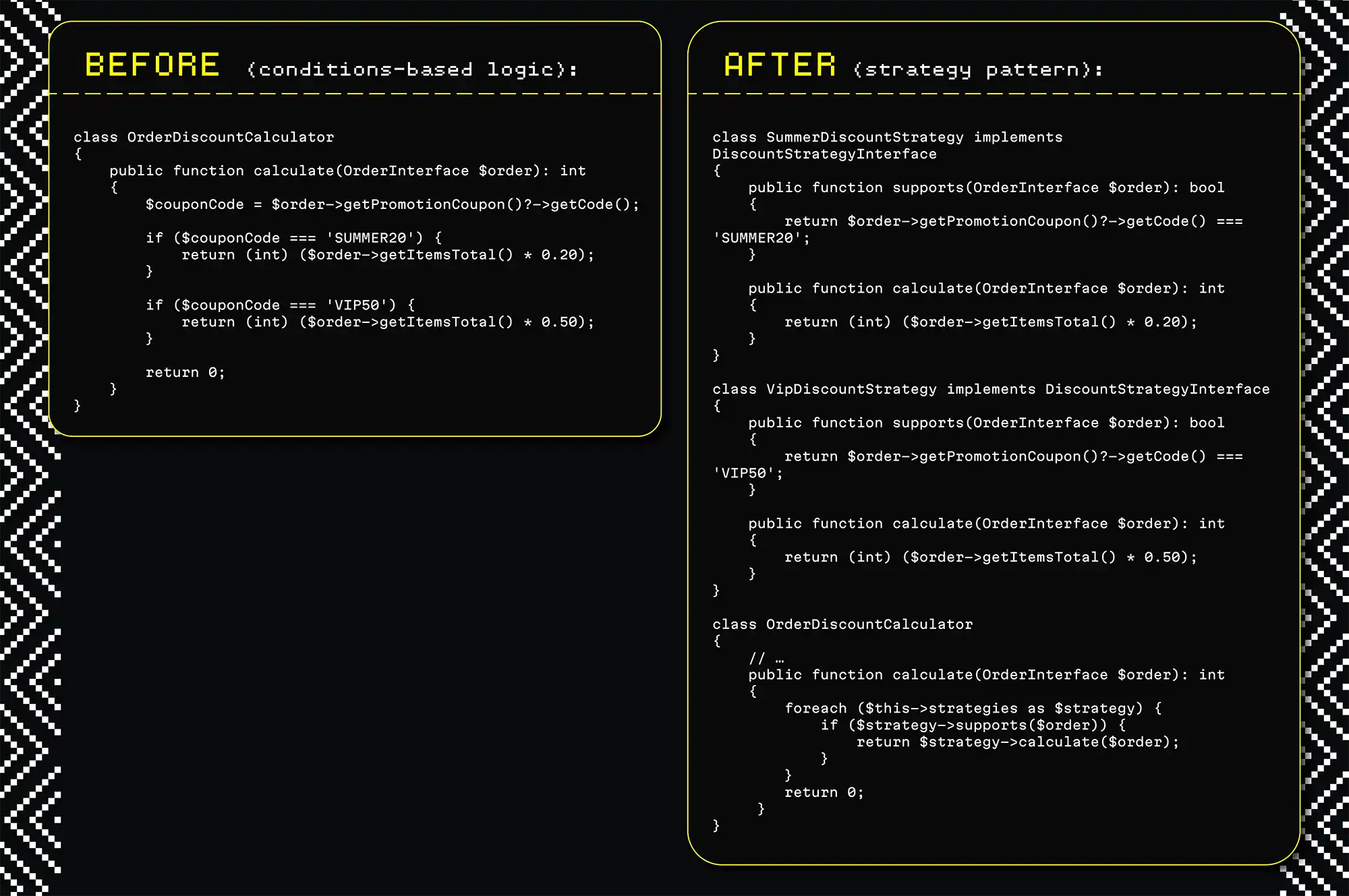
Architectural rigidity. Small logic changes (e.g., in promotion engines) require modifications across multiple, unrelated modules.
Quality erosion. The team spends more time fixing regressions than delivering new features.
High cognitive load. A lack of standards and poor code readability extends developer onboarding from days to weeks.
Performance degradation. Increasing database size causes exponential system load.
Security vulnerabilities. Running on unsupported library versions leads to frequent security gaps requiring manual patches.
What exactly is Code Refactoring?
Refactoring is the systematic process of improving a system's internal structure while preserving its functional integrity. It involves streamlining the architecture, decoupling modules, and enhancing code quality. This ensures the platform remains maintainable, predictable, and scalable.
Core Principles of Professional Refactoring
Business continuity. We employ evolutionary approaches like the Strangler Fig Pattern to replace legacy modules incrementally without downtime.
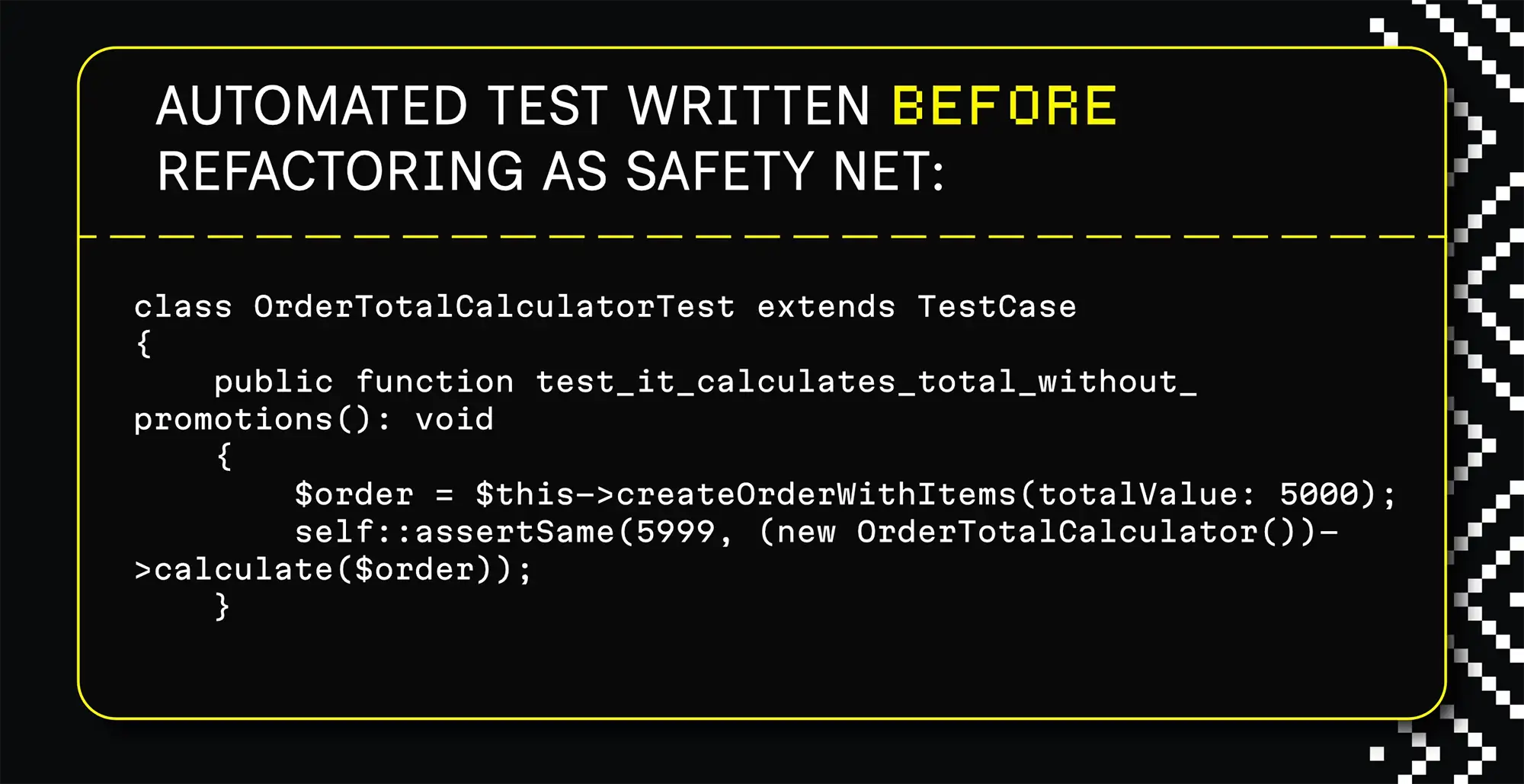
The safety net. Refactoring must be backed by automated tests (PHPUnit, Behat) to prevent unintended changes in business logic.
Standardization. Implementing SOLID principles, Clean Code, and PSR standards reduces long-term maintenance costs.
Separation of concerns. Structural changes are strictly isolated from functional updates.
Atomic changes. Modifications are made in small, reversible steps to ensure every step is testable.
Resource optimization. Well-structured code executes fewer redundant operations, directly lowering CPU and memory usage.
Expert Insight: Automated Testing – Cost or Investment?
8 Architectural Anti-patterns in Sylius Projects that Generate Technical Debt
In complex e-commerce systems, ignoring technical debt leads to a platform too rigid to adapt to business requirements. In Sylius–based projects, debt often accumulates when teams diverge from the framework's native patterns:
1. Tight coupling
Directly overriding core classes instead of using Symfony's extension mechanisms. The correct approach involves Decorators and Compiler Passes.
2. Domain layer erosion
Business logic concentrating in "God Classes." A common mistake is overloading the OrderProcessor. Sylius promotes a Chain of Responsibility pattern, utilizing smaller, specialized processors.
3. Data layer degradation (N+1 problem)
A lack of query optimization in large catalogs (50k+ SKUs) leads to massive database overhead and poor TTFB (Time to First Byte).
4. Missing abstraction in integrations
Direct coupling with ERP, PIM, or Payment APIs creates vendor lock–in and inflates future migration costs.
5. Lack of asynchronicity
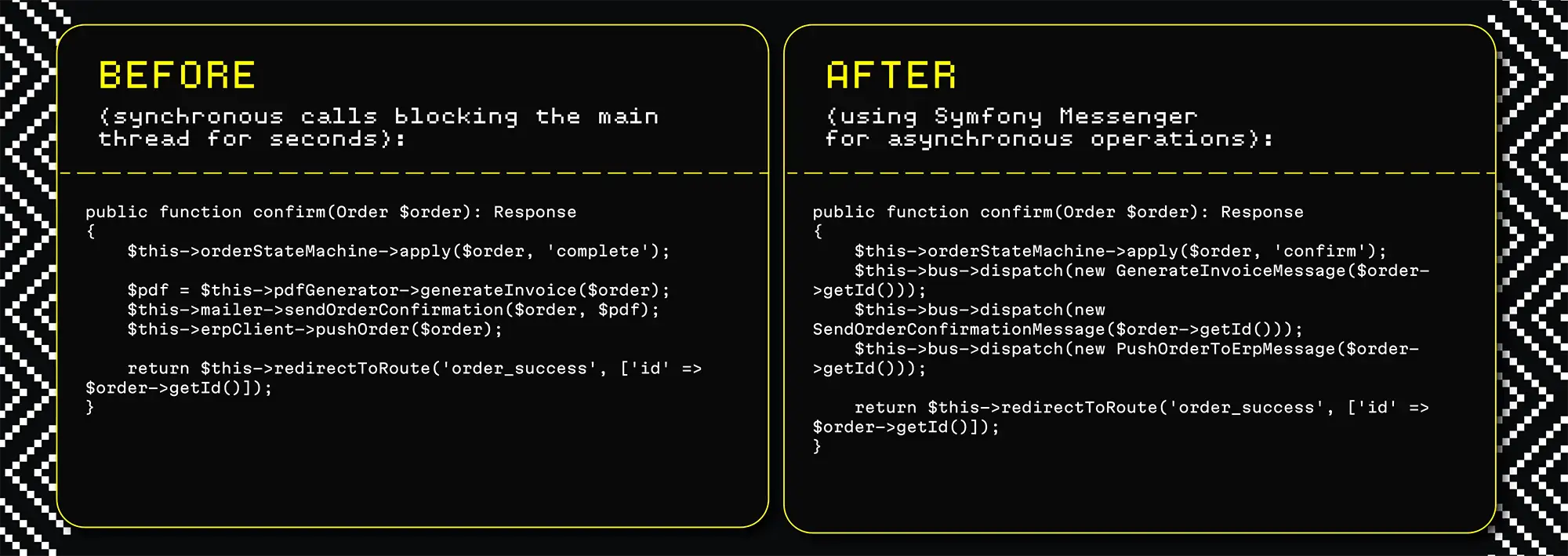
Performing time-consuming I/O tasks (syncing orders, generating PDFs) within the main HTTP request thread. The standard solution is Symfony Messenger for background processing.
6. Resource bundle competency debt
Bypassing Sylius Resource Bundle's native CRUD and routing mechanisms, leading to non-standard, hard-to-maintain controllers.
7. Legacy stack
Staying on end-of-life PHP or Symfony versions, which blocks library updates and increases security risks.
8. Lack of automated tests
The absence of a safety net makes every refactoring attempt a high–risk operation for critical business processes.
Our Approach? Architectural Audit and Project Rescue
At Commerce Weavers, we don't start refactoring by writing code; we start by safeguarding your business stability. Our Project Rescue service begins with a deep technical audit and stakeholder workshops.
We analyze security, database performance, and ERP/CRM integrations to understand why the platform is failing to meet business goals. These workshops map key processes and identify bottlenecks that aren't visible in the code alone. This makes refactoring predictable and allows us to create a roadmap that pays off debt without interrupting sales.
Read: Quality & Performance audit for e-commerce. Clarity before code.
Business ROI. How Refactoring Builds Capital Value
Refactoring is an investment in long-term platform equity:
Increased velocity. A clean architecture allows teams to ship features faster as they no longer fight regressions and complex dependencies.
Lower TCO. Optimized queries and clean code reduce server resource consumption and maintenance overhead.
Operational security. Automated tests mitigate the risk of system failures and costly sales downtime.
Avoiding "the big rewrite". Systematic refactoring prevents the ultimate technical cost – the need to scrap the platform and start from scratch.
Does your system need expert support? Book a free technical consultation to see how our Project Rescue service can optimize your architecture.
FAQ. Code refactoring in e-commerce
Does refactoring mean freezing new feature development?
No. We use an incremental approach that allows us to replace legacy code systematically while the platform remains fully operational.
How long does refactoring take in a Symfony project?
It depends on the depth of the debt. We start with a technical audit and 1-3 days of workshops. Initial performance gains are often visible within a few sprints.
Is it better to build from scratch?
Rewriting from zero carries a massive risk of losing the "business tribal knowledge" embedded in the existing system. Refactoring preserves what works while fixing the bottlenecks.
How does refactoring impact server costs?
Proper refactoring optimizes database queries and removes redundant operations, allowing your system to handle more traffic without scaling the underlying infrastructure..