What is Sylius?
Sylius is an Open Source e-commerce framework built on the Symfony ecosystem, designed to create scalable sales platforms tailored to unique business processes. Unlike turnkey solutions, it provides architects with total control over system design and its long-term evolution.
Expert Insight: What is Sylius?
Core Technological Components
Architecture:
Modular architecture based on Symfony bundles.
Support for both modular monolith and microservices architectures, with a focus on composable commerce applications.
Technological Foundation:
Symfony 6.4 / 7.x.
PHP 8.2+ / 8.3.
Doctrine ORM.
Frontend options:
Traditional frontend powered by Twig.
Decoupled frontend applications (e.g., Next.js) interacting with the API layer (Headless).
Development Standards:
Sylius Architecture under a Tech Lead’s Microscope: Enterprise Standards in Practice
The primary advantage of Sylius is not its out-of-the-box feature count, but an architecture that inherently supports agile and flexible system evolution.
The platform is engineered to model complex business processes without compromising the integrity of the system core.
Domain-Driven Design and the Resource Model. One of the foundational pillars of Sylius is the Resource Layer, which defines a consistent way to manage domain models. Every system element – whether a Product, Order, or Promotion – is represented as a resource comprising a Doctrine Entity, a Repository, and dedicated business logic. This allows for the introduction of new domain elements without modifying the platform's core, significantly streamlining development.
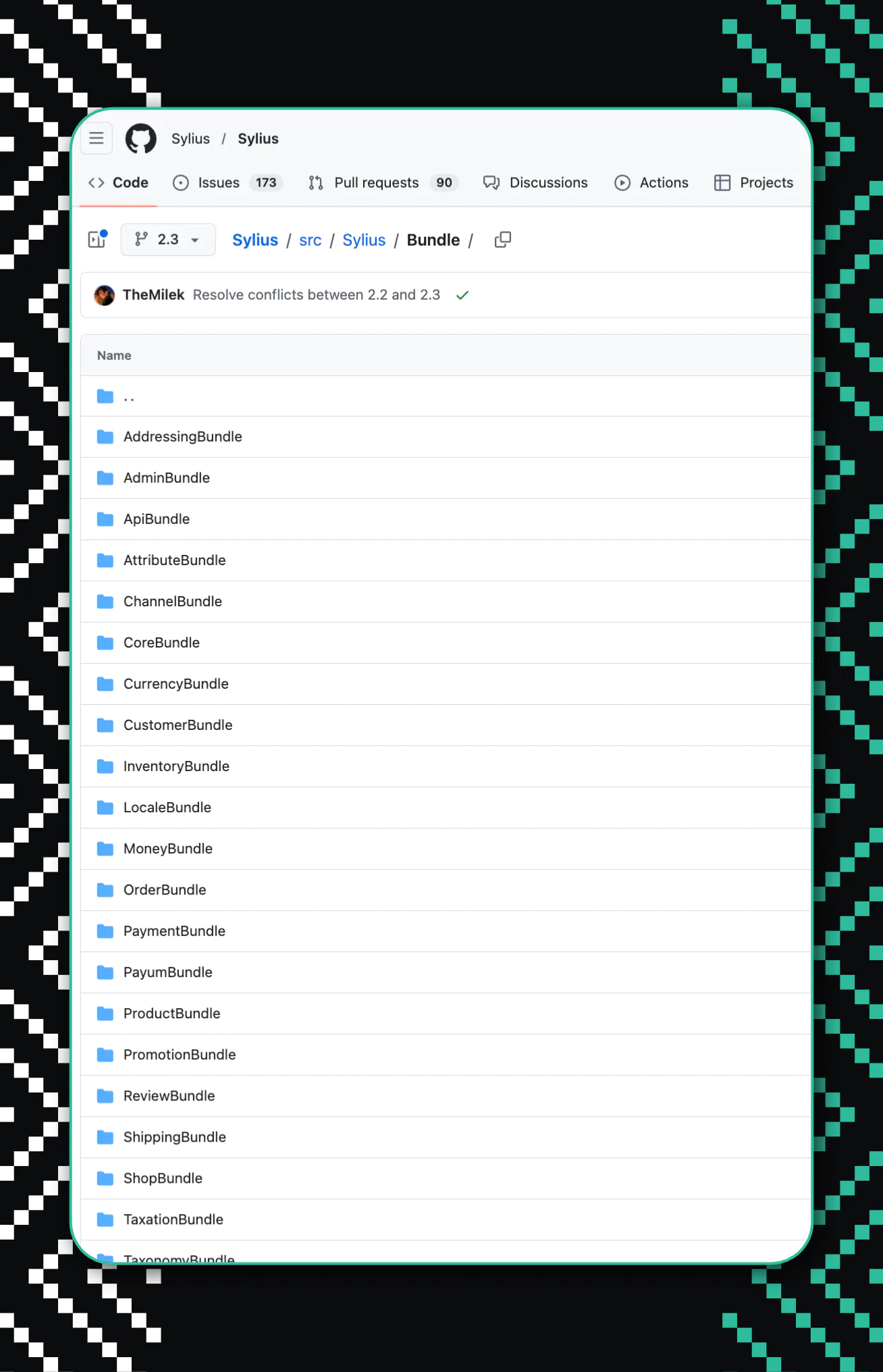
Modular Architecture via Symfony Bundles. Sylius is composed of decoupled modules based on Symfony’s bundle concept. Key areas such as the Product Catalog, Promotions, Orders, and Payments are logically separated and can be extended or entirely replaced with custom implementations. This approach enables the platform to evolve as a Modular Monolith or integrate seamlessly into a Microservices-based architecture.
State Machines for Process Management. Sylius utilizes State Machines to manage the lifecycles of orders, payments, and shipments. Transition logic is defined through configuration, allowing for the mapping of highly complex business scenarios. State changes can trigger events handled by Symfony Messenger, enabling asynchronous integrations with ERP, logistics, and payment gateways.
API-first and Headless Architecture. Sylius is a natural fit for the modern Headless Commerce model. The backend serves as a stateless business logic engine, communicating with multiple sales channels via API. Many projects leverage API Platform to simplify the creation of REST interfaces and documentation. This allows Sylius to simultaneously power web storefronts, mobile apps, POS systems, and marketplace integrations.
Scalability and Performance. The architecture allows for effortless scaling in Docker or Kubernetes environments. System performance relies on multiple optimization layers: HTTP Cache (e.g., Varnish or CDN), Application Cache in Redis, and asynchronous event processing via Symfony Messenger. For large–scale product catalogs, search operations are typically delegated to specialized engines like Elasticsearch or Meilisearch.
BDD and System Testability. A standout feature of the Sylius ecosystem is the rigorous focus on automated testing and Behavior-Driven Development (BDD). The core is developed using Behat test scenarios written in Gherkin, describing system behavior from a business process perspective. This ensures that critical paths – such as checkout, payments, and promotions – are covered by a comprehensive suite of functional tests.
Read more: How to prepare your engineering team for a Sylius implementation?
The Plugin System and Sylius Extensibility
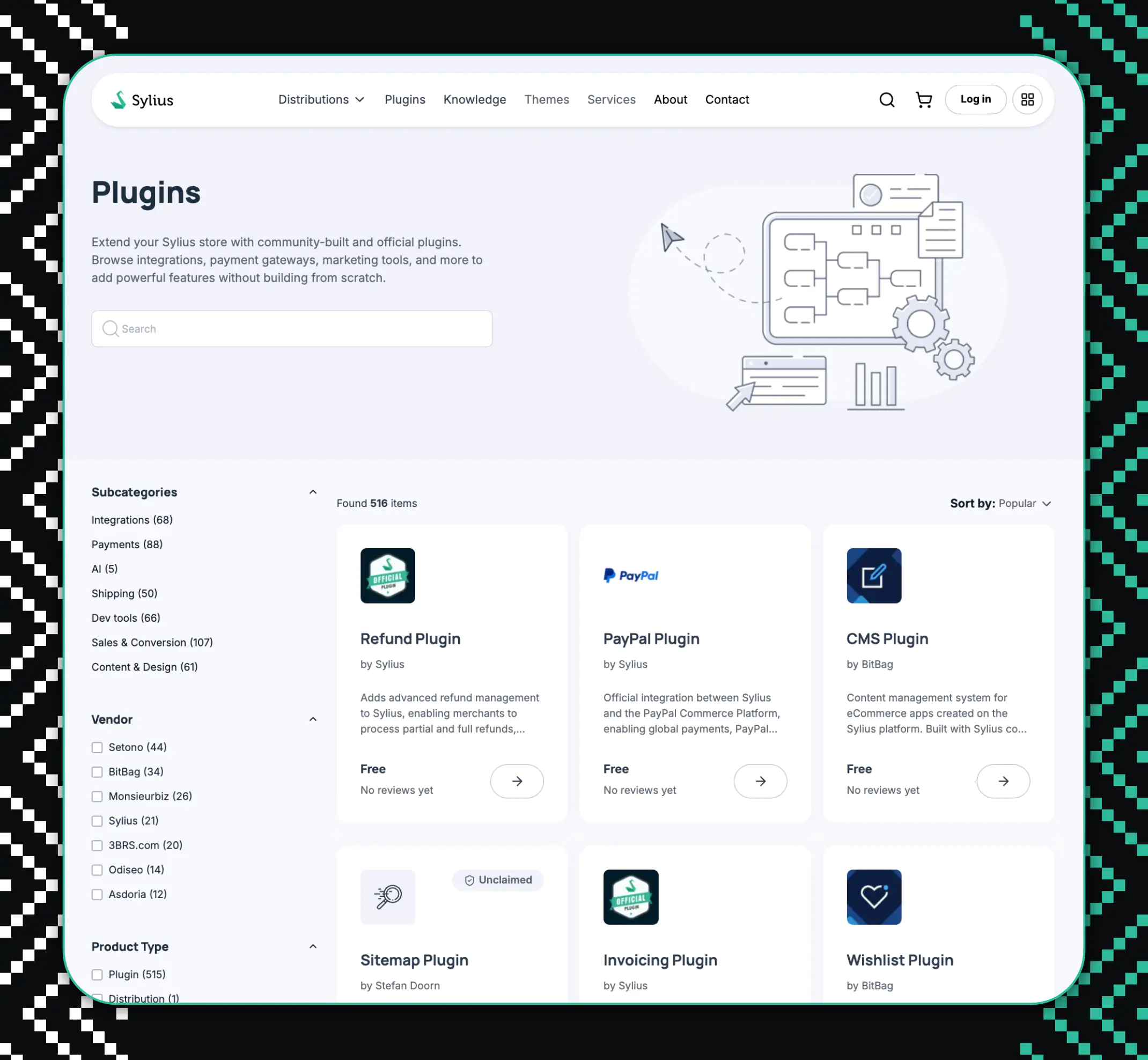
A cornerstone of the Sylius architecture is its robust plugin system, which allows for extending platform functionality without altering the core codebase. Plugins are implemented as standard Symfony Bundles and managed via Composer, ensuring seamless integration that adheres to the framework’s underlying architectural principles.
This approach enables the addition of new features – such as payment gateways, marketing modules, or custom sales logic – without modifying the system core. In practice, this significantly mitigates the risk of accumulating technical debt.
For engineering teams, this modularity means the platform can be developed as a collection of independent components. Each functional block can be maintained, updated, or replaced in isolation, ensuring that changes to one part of the system do not compromise the stability of others.
Explore our Sylius Plugins.
Sylius Security and Stability. Regression-Proof Code
For a CTO, the critical metrics for evaluating technology are the long-term maintenance cost and the safety of architectural changes. Sylius distinguishes itself from competitors by deeply embedding a culture of automated testing into its core.
Thanks to its strong roots in Behavior-Driven Development (BDD), engineering teams gain full control over regression. Every framework update, checkout process modification, or new integration deployment ceases to be a high-risk operation that could paralyze core store functions. This stability is further reinforced by native support for API Platform, which streamlines the generation of professional documentation and positions Sylius as a premier solution within the Composable Commerce ecosystem.
The Cost of Sylius Implementation
Sylius is available in two primary variants: the Open Source edition and the commercial Sylius Plus. While the Open Source version provides a robust technological foundation for any e-commerce platform, Sylius Plus extends this with a suite of enterprise-ready modules, including advanced B2B features, marketplace capabilities, and sophisticated multi-inventory/multi-channel management.
While the core framework is free, the total cost of a Sylius implementation is primarily driven by engineering resources and project scale. The most significant budgetary factors include: the degree of customization, integrations and frontend architecture.
A typical project team consists of Symfony Backend Developers, Frontend Developers, DevOps Engineers, and QA Specialists. In many enterprise scenarios, the Total Cost of Ownership (TCO) in the long run proves to be lower than with SaaS solutions. This is because the organization retains full architectural control, avoiding vendor lock-in and scaling the platform strictly according to its own technological roadmap.
Why do companies migrate to Sylius?
The decision to migrate an e-commerce engine is usually an escape from constraints that throttle growth. Companies that have outgrown "out-of-the-box" SaaS platforms or rigid, legacy monoliths turn to Sylius for predictability and the removal of technical barriers. What are the core drivers of this transformation?
Performance & Efficiency. The lightweight nature of the framework ensures a rapid TTFB (Time to First Byte) and seamless operation during high-traffic peaks.
Technical Debt Mitigation. Adherence to Clean Code ensures that the system remains flexible and cost-effective to maintain, even after years of continuous development.
Scalability. Engineered to handle enterprise-grade catalogs with millions of SKUs and thousands of concurrent orders per hour without architectural degradation.
Process Flexibility. The ability to model non-standard business logic – such as complex B2B pricing engines, subscription models, or sophisticated split–payment scenarios – directly within the domain layer.
Read more: 5 scenarios where Sylius outperforms SaaS platforms.
Expert Insight: Why Sylius? Technical Perspective
When is Sylius a POOR Choice?
Sylius is not a universal "one-size-fits-all" solution. Investing in this framework is technically and economically unjustified in three specific scenarios:
Small-scale Operations. If you are managing a limited catalog of a few dozen SKUs and running a standard B2C process, platforms like Shopify or WooCommerce will be more cost–effective.
Lack of Engineering Resources. Sylius demands consistent access to Symfony/PHP expertise, a commitment to code quality, and robust CI/CD processes. If you are looking for a "no-code" or "drag-and-drop" system, you will face a prohibitively high entry barrier and underutilize the platform’s potential.
Preference for a Full SaaS Model. By choosing Sylius, you gain full code ownership and avoid vendor lock-in, but you also assume responsibility for server architecture and maintenance. If your strategic goal is the total outsourcing of infrastructure and you do not require custom business logic, cloud-native SaaS solutions remain the better fit.
Who is Sylius the Best Choice For?
Sylius was engineered for organizations where the rigid, standard features of "out-of-the-box" platforms have become a barrier to growth. Choosing this framework is justified whenever unique business logic serves as a competitive advantage and the underlying technology must keep pace with rapid operational scaling.
Choose Sylius if:
You have outgrown your current system and hit a "performance ceiling" that limits further expansion.
You are building a complex Marketplace, advanced B2B platform, or a Subscription portal requiring non-standard checkout and billing flows.
You require highly flexible logistics and support for multiple sales channels (Omnichannel) within a unified backend.
Expert Tip: Checklist for international e-commerce expansion.
Frequently Asked Questions about Sylius
How much does a Sylius implementation cost?
The total investment depends primarily on the degree of customization and the complexity of third-party integrations. Projects range from focused, mid-market deployments to large-scale Enterprise e-commerce platforms with bespoke business logic.
Can any PHP developer work with Sylius?
Working effectively with Sylius requires deep proficiency in the Symfony ecosystem and modern design patterns. Core competencies include Doctrine ORM, Symfony architecture, and API Platform. While developers without prior Symfony experience can adapt, the learning curve will significantly extend the initial implementation timeline.
Is Sylius suitable for a Marketplace model?
Yes. The platform’s modular architecture is ideal for building multi-vendor systems with support for complex commission structures and payment split integrations. For projects requiring out-of-the-box marketplace features, the Sylius Plus Marketplace Suite provides a ready-to-use extension for advanced vendor management.
Which companies use Sylius?
Sylius is utilized by mid-market leaders and global Enterprise organizations where e-commerce is a mission-critical channel. Notable examples include Intersport, Carrefour, PwC, and Würth.
Read our case studies to see how we build dedicated B2B platforms from scratch using Sylius.
Is Sylius scalable enough for high-traffic platforms?
Absolutely. Sylius was engineered for projects demanding architectural scalability and business flexibility. Built on Symfony, it can evolve as a Modular Monolith or integrate into a Microservices architecture. With native support for HTTP caching, message queues and external search engines, it efficiently handles massive product catalogs and high concurrent traffic.
Does Sylius support international sales (Global Commerce)?
Yes. The framework allows for managing multiple currencies, languages, and complex tax configurations within a single installation. Its multi-channel model enables managing different stores, markets, or brands from a unified backend while maintaining a shared product and customer database.