Why Most E-commerce Projects Skip the Proof of Concept Stage, and Why That Is a Mistake
In many e-commerce projects, the Proof of Concept stage never happens. Companies move straight from an idea and initial assumptions into full system development. On paper, this can look efficient: fewer stages, a faster start, and something “working” sooner. In reality, this shortcut often means making expensive technology decisions without properly checking whether the chosen direction is right.
As a developer and co-owner of a software house, I see this pattern regularly. A project starts with a lot of confidence and ends with fixes that could have been avoided. The scope changes, the timeline shifts, the budget grows, and the business team hears that “this technical blocker only became visible during development.”
That is usually when the real cost of skipping validation becomes obvious. The lack of a validation stage did not speed the project up. It only pushed the hardest decisions further down the road, where they became much more expensive.
To understand where this mistake comes from, we first need to be clear about what a Proof of Concept actually is and what it definitely is not.
What Is a Proof of Concept?
A Proof of Concept is not a presentation, a mockup, or a technical sketch. It is working software built around a specific business problem. Its purpose is not to outline the entire system. Its purpose is to test an important business need in a real technological context.
In practice, an e-commerce POC may cover custom catalog logic, pricing rules, user roles, a specific checkout flow, selected critical integrations, or parts of the administration panel. The goal is not to build the whole system. The goal is to build just enough to make a well-informed decision.
This matters because many companies still treat a POC as a soft “pre-project” stage. For us, a well-prepared Proof of Concept is part of the project, much like a carefully run audit. Both give you clarity before the most expensive phase of development begins.
What a Proof of Concept Is Not
A POC is not a production-ready implementation. It is also not an MVP in the classic sense, assuming we define an MVP as the first version of a product intended for real users or a production launch. A Proof of Concept is not meant to solve everything. It is meant to answer the most important questions as early as possible.
It is not an excuse for an unclear scope either. A well-prepared POC is not about writing code and “seeing what happens.” Quite the opposite. To be useful, it has to be planned properly.
Before development starts, you need to know:
which problem you are validating,
what result will count as success,
what you are deliberately not building at this stage.
That is what separates a useful Proof of Concept from projects that are only called a POC, but are really just poorly defined development work.
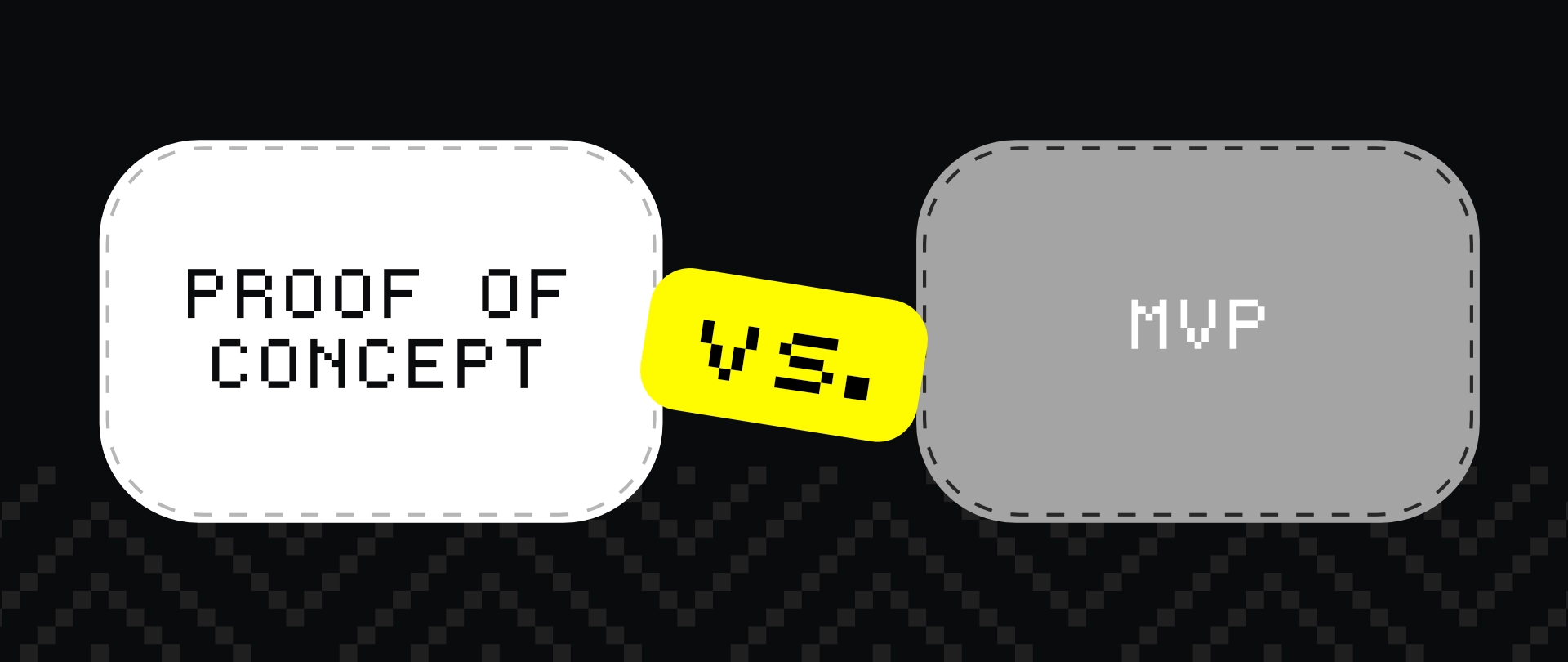
Proof of Concept vs MVP: What Is the Difference?
This is one of the most common questions, and for good reason. Proof of Concept and MVP are often confused. A Proof of Concept is used to validate assumptions. An MVP is used to launch the first version of a product. A POC answers the question: Does this solution make sense, and how should it work? An MVP answers the question: Can we release the first version to the market or to users?
A well-designed POC often becomes the foundation for an MVP. It is not a cost outside the project. It is a way to make sure the MVP is not built on the wrong assumptions.
When Does a Proof of Concept Make Sense in E-commerce?
A Proof of Concept makes the most sense when the level of uncertainty is higher than usual. In other words, when “let’s build the store and see what happens” is not a responsible answer.
This usually applies to several types of e-commerce projects. First, a POC is useful when the business logic is custom. This includes complex pricing models, B2B workflows, product configurators, marketplace logic, or unusual user roles. Second, it makes sense when the current platform is starting to limit growth and the company does not want to commit to a full migration before validating the new direction. Third, it is valuable when the project includes integrations that are important, risky, or difficult to estimate without testing them in practice.
In these situations, a Proof of Concept is the cheapest way to reduce mistakes that would cost much more later.
How Long Does a Proof of Concept Take at Commerce Weavers?
The timeline depends on the scope, but a well-designed Proof of Concept should not drag on for months without a clear end point. If it does, it stops doing its job. Instead of creating clarity, it starts repeating the same problems as poorly managed development projects: expanding scope, delayed decisions, and no concrete result.
A useful POC should be tightly scoped and time-boxed. That gives the team enough room to build a working part of the system, validate key assumptions, and give the business a solid basis for the next decision. In our model, this stage is kept within a short, controlled horizon. That is why we define the scope and prepare a responsible estimate from the very beginning.
Estimated Proof of Concept Timeline at Commerce Weavers
StageWhat happensEstimated time
Who Is This Model Best For?
This model is not for everyone, and it should not be treated as the default answer to every e-commerce project. It works best when the level of complexity or risk is higher than usual.
It is especially useful for companies building a custom product, not just another store based on a ready-made template. It’s a good approach for organizations that have already dealt with delayed projects and want to close the decision-making stage in a more predictable way.
Why does this approach work? The reason is simple. It matches the way responsible business decisions are made. As a company co-owner, I would not accept a project without budget control, a clear scope, and a concrete result at the end. That is why we do not build projects we would not buy ourselves.
If a cooperation model does not make sense from the perspective of someone responsible for financial results and business risk, it should not be offered to clients as a “proven” approach.
Why Trust in IT Projects Has Become Harder to Earn, and Why We Work in a Fixed-Price Model
It is difficult to talk about Proof of Concept today without looking at the wider context of the IT market. AI did not create the industry’s problems, but it exposed them very effectively.
For years, too many projects were based on average teams sold as expert teams, “agile” used as an excuse for a lack of predictability, and billing models that protected the vendor while leaving the client with growing uncertainty.
This worked as long as the market kept growing and companies were willing to accept chaos in exchange for speed. Today, that tolerance is much lower. Inefficiency becomes visible faster. Lack of competence shows up almost immediately. And trust, once lost, is very hard to rebuild.
That is why a conversation about a POC is really a conversation about responsibility. It is about whether someone truly understands the problem before development begins. Whether they can estimate the scope honestly. Whether they are able to say, “This cannot be responsibly estimated today,” instead of selling a promise they cannot deliver.
For the same reason, we decided to work with a fixed-price POC model. If the project is well understood, the scope is clear enough, and the team has experience with similar work, it is possible to prepare a detailed and binding estimate. If not, the honest answer is not “let’s start and see.” The honest answer is that the project cannot be estimated responsibly at this stage. That is why we work in a model that is still unusual in parts of the market: detailed analysis at the start, clearly defined scope, a binding estimate, and a concrete result. The rule is simple: if we are wrong, that is our problem, not the client’s.
Not every project fits this model, and we do not try to force every project into it. But when the scope can be responsibly closed, a fixed-price POC gives the business something that is often missing in technology projects today: predictability that is not an empty promise.
FAQ: Proof of Concept in E-commerce
What is a Proof of Concept in e-commerce?
A Proof of Concept in e-commerce is a working version of a selected part of the system. It helps validate key business and technical assumptions before a full implementation begins.
How long does a Proof of Concept take?
It depends on the scope, but a well-prepared POC should be completed within a short and controlled timeframe, so it can quickly support a business decision. At Commerce Weavers, this usually takes up to around three months.
Can a POC be developed further?
Yes. If it is designed properly, a POC can become the foundation for an MVP and the next stages of the system.
Do I need a full specification to start?
No. At the beginning, a well-described business problem, goal, and current limitations are enough. The specification can be clarified during the discovery and estimation process.
Want to Check Whether a POC Makes Sense for Your Project?
You do not need a complete specification or a fully planned project to start. At the beginning, a short description of the problem, the business goal, and the current blockers is usually enough.
This allows us to assess whether the project can be responsibly delivered as a Proof of Concept and whether we can prepare a reliable estimate.
Get in touch to book a technical consultation.