The most expensive failure modes in digital transformation occur when organizations mistake these developmental phases. Enterprises routinely execute a full MVP development cycle when they should have first neutralized deep architectural risks via a POC or conversely, they over-engineer an internal POC when the business model demands immediate market validation.
For executive decision-makers, the dilemma boils down to a singular architectural question: Which category of risk must be neutralized first?
Deconstructing POC vs MVP: The Core Business Definitions
From an architectural standpoint, a POC answers the question: Can this application core be reliably engineered, and do our technical assumptions hold under load? An MVP answers an entirely different proposition: Does the target market demand this product, and will end users actively adopt the interface?
This distinction dictates the engineering lifecycle. If the primary threat to project success resides in data model persistence, third-party system integrations, legacy migration paths, or convoluted business logic, the development team must execute a POC. If the dominant unknown centers on customer acquisition, conversion metrics, product-market fit, or user experience (UX) paradigms, the project must initiate via an MVP.
| Operational Vector |
POC |
MVP |
| Primary Objective |
Validate technical and architectural viability |
Validate market demand and iterate on product concepts |
| Critical Question |
Can this system be built reliably and scalably? |
Do end users demand this system and how do they interact with it? |
| Dominant Risk Vector |
Technology stacks, service architecture, integrations, data mapping |
Market adoption, transaction volume, conversion drop-off, business model |
| Primary Stakeholders |
CTO, tech lead, operations |
CEO, CEO, Chief Product Officers, Growth Teams, Commercial Directors |
| Lifecycle Placement |
Prior to full-scale framework development |
Prior to global product scaling and optimization phases |
| Target Evaluation |
Core business logic, integration contracts, workflows, schema validation |
User behavioral analytics, demand volume, pricing strategies, UX friction |
| End-User Exposure |
Typically restricted to internal stakeholders; isolated from the public |
Yes |
| Core Technical Value |
Eliminates systemic architectural failures early. |
Maximizes the velocity of empirical market feedback loops |
When a Proof of Concept is the Superior Architectural Choice
The prevailing corporate urge is often to reach live end users as rapidly as possible. Velocity is frequently viewed as a competitive advantage, making the MVP the default starting point. However, skipping foundational validation is highly dangerous. In complex enterprise environments, the greatest threat to a project does not reside in customer demand, but in the functional viability of the underlying technology stack and the operational fulfillment model.
This reality is highly evident in enterprise e-commerce, where engineering boundaries extend far beyond a basic shopping cart interface. Behind the storefront presentation layer resides a highly coupled ecosystem of data processing pipelines, logistics loops, inventory synchronization layers, and financial calculations that dictate the profitability and scaling potential of the enterprise. Consequently, mature implementations initiate development with an in-depth B2B e-commerce discovery workshop to map functional scope and eliminate structural pitfalls before writing code.
A Proof of Concept must be prioritized whenever the architecture introduces:
Bidirectional data sync with legacy ERP, PIM, OMS, or WMS platforms
Complex, contract-bound algorithmic pricing matrix structures
Non-linear B2B multi-tier procurement and approval state machines
Custom, rules-driven product configurators and composition layers
Multi-vendor marketplace splitting and payout engines
Omnichannel or multi-channel synchronization mechanics
Comprehensive system migrations away from highly customized legacy backends
In these scenarios, launching an accelerated MVP introduces an illusion of progress while failing to resolve the technical realities that govern system survival. If the software foundation is built on unverified integration patterns, entering the market does not solve the underlying technical volatility– it merely delays systemic architecture failure to a point where fixing it is exponentially more expensive.
Executing a targeted POC systematically resolves the core technical dependencies of the application:
Are the target third-party API integration contracts viable and performant?
Where do high-volume transactional bottlenecks and race conditions reside?
Which specific database schema design and data model optimizes performance?
Does the mapped operational workflow execute deterministically under automated conditions?
What is the precise, data-backed total cost of ownership (TCO) for the full platform rollout?
By answering these architectural queries prior to major capital expenditure, a POC consistently saves more capital than it costs. It insulates the organization from high-risk investments before entering the most resource-intensive development phases.
When a Minimum Viable Product is the Correct Strategic Action
Not every enterprise architecture demands extensive pre-development technical validation. When the application core utilizes highly predictable, well-trodden software patterns and the target integrations are straightforward, the primary existential risk shifts entirely to market reception. Under these conditions, the dominant variable is not technical execution, but buyer psychology and behavioral conversion metrics. The engineering team must pivot to address a different core question: Do customers actively want this solution?
In these business landscapes, launching an MVP is the most logical strategic maneuver because it exposes the value proposition to live market forces immediately. Instead of spending months designing systems in isolation, the enterprise deploys a lean, production-grade iteration of the product to capture concrete transactional data, guiding next-phase development using empirical user behaviors rather than executive hypotheses.
This development track is optimized for validating:
Unique, unverified subscription or recurring revenue mechanisms.
Niche, hyper-focused vertical marketplace platforms.
Direct-to-Consumer (DTC) digital brand rollouts.
Experimental transactional channels and headless touchpoints.
Disruptive, high-friction digital shopping experiences.
The greatest failure mode in these environments is spending consecutive quarters engineering a bulletproof, infinitely scalable system completely isolated from actual consumer interaction. Even the most elegant software architecture carries zero business value if it fails to resolve a real customer pain point or convert storefront traffic into confirmed transactions.
A production MVP empowers the enterprise to:
Compress the time-to-market required to secure empirical user feedback.
Measure authentic conversion rates and checkout funnel friction under live conditions.
Analyze actual user navigation paths and search discovery behaviors.
Validate volume-driven pricing elasticities and promotional models.
Determine with statistical certainty whether to allocate further engineering resources.
Explore our production history across modern architectures: Commerce Weavers Case Studies.
When the existential threat to a project lives on the market side of the equation, an MVP is the mathematically sound deployment strategy. Establish demand metrics first, then scale the underlying infrastructure to match transaction volumes.
Executive Perspectives. Capital Allocation vs Technical Debt
For corporate boardrooms and technology directors, choosing between a POC and an MVP must transcend superficial industry buzzwords. This decision dictates how the enterprise manages risk allocation. A healthy software lifecycle begins by auditing exactly what the organization does not yet know.
When the primary unknown is architectural, operational, or infrastructural, the Proof of Concept is the correct point of inception. This path is mandatory when the total cost of implementation remains a projection, when it is unverified whether the core architecture can handle peak concurrent transactions, when third-party ERP/PIM data pipelines are unstable, or when it is uncertain if the software framework will scale gracefully over a multi-year lifecycle. Moving into full-scale development under these conditions means gambling capital before defining the technical boundaries of the asset. A POC establishes a foundation built on data, allowing subsequent code phases to proceed with predictable velocity.
Conversely, if the technology stack is highly standardized and the primary unknown centers on market adoption, the MVP is the superior tool. This applies when customer acquisition costs are unverified, when it is unknown if the checkout funnel will yield a viable conversion rate, or if the digital experience resolves user friction well enough to drive customer retention. In this landscape, the most damaging mistake is over-engineering a highly resilient platform for a customer base that does not exist.
From the Chief Executive Officer's perspective, this choice governs optimal capital allocation, resource utilization, and organizational learning velocities. From the Chief Technology Officer's viewpoint, it is an exercise in mitigating technical debt, controlling architectural risk, and maintaining the correct order of operations. Both workflows rely on an identical paradigm: isolate the primary unknown first, then select the exact software methodology to resolve it.
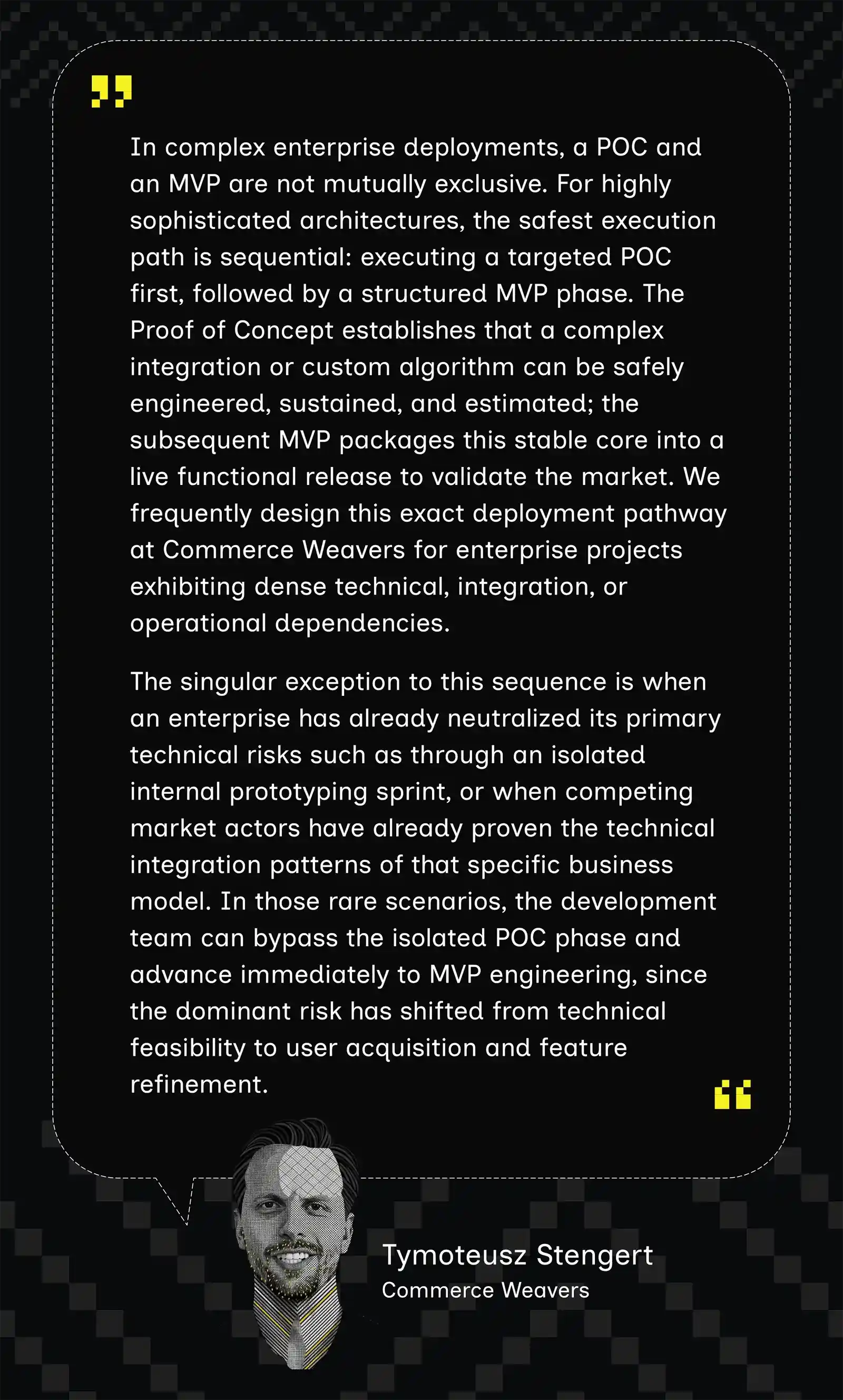
In complex enterprise deployments, a POC and an MVP are not mutually exclusive. For highly sophisticated architectures, the safest execution path is sequential: executing a targeted POC first, followed by a structured MVP phase. The Proof of Concept establishes that a complex integration or custom algorithm can be safely engineered, sustained, and estimated; the subsequent MVP packages this stable core into a live functional release to validate the market. We frequently design this exact deployment pathway at Commerce Weavers for enterprise projects exhibiting dense technical, integration, or operational dependencies.
The singular exception to this sequence is when an enterprise has already neutralized its primary technical risks such as through an isolated internal prototyping sprint, or when competing market actors have already proven the technical integration patterns of that specific business model. In those rare scenarios, the development team can bypass the isolated POC phase and advance immediately to MVP engineering, since the dominant risk has shifted from technical feasibility to user acquisition and feature refinement.
Why Commerce Weavers Prioritizes the POC Paradigm
When building customized enterprise e-commerce systems, the primary engineering risk rarely resides within the presentation layout or the standard checkout button. The structural risks live within hidden cross-system dependencies, non-linear business logic, and backend integration touchpoints.
Because of this systemic volatility, we frequently counsel partners to launch complex initiatives via a structured, fixed-price Proof of Concept model.
A POC and an MVP are not interchangeable development alternatives. They are separate execution phases designed to solve completely different structural problems.
If you deploy your engineering team to answer the wrong question first, you will spend your budget building a highly performant application that your business cannot utilize or that your market does not demand. Making the correct architectural decision at inception saves significantly more resources than trying to optimize flawed development patterns down the line.
Need to determine whether your enterprise initiatives require a targeted POC, a production MVP, or a sequential combination of both?
You do not need a massive, pre-drafted technical specification document. Simply provide a concise summary of your business model, core operational goals, and known infrastructure constraints.
Are your integration paths already verified and you are fully prepared to launch a production-grade MVP? Explore our structural delivery methodologies, contact our architectural group and receive a transparent development evaluation within 24 hours.
FAQ – Frequently Asked Questions: POC vs MVP
Which approach is superior: a POC or an MVP?
Neither approach is universally superior; they are engineered to resolve entirely different categories of risk. A POC is designed to validate technical feasibility, backend integration viability, and structural system architecture. An MVP is engineered to test real market demand, user acquisition funnels, and customer interaction paradigms.
Check: Proof of Concept in e-commerce.
Is it possible to execute a POC first, followed by an MVP?
Yes. In complex enterprise environments, this sequential strategy represents the absolute safest engineering methodology. The POC explicitly proves that a highly complex integration or proprietary calculation engine can be constructed and maintained reliably, while the subsequent MVP wraps that validated architecture into a live production release to measure market adoption.
Does a Proof of Concept (POC) face live retail customers?
Typically, no. A POC is engineered specifically to validate technical and business hypotheses for the internal development team, executive boards, and core stakeholders. An MVP, by contrast, is deployed directly to production environments to handle authentic consumer transactions. However, there are no structural barriers preventing an engineering team from systematically refactoring a high-integrity POC into the final production software asset and this is exactly how we approach architecture at Commerce Weavers.
Should a newly launched e-commerce platform begin with a POC?
If the planned architecture introduces deep bidirectional enterprise integrations (ERP/PIM/WMS), custom contract-pricing engines, non-linear procurement workflows, or extensive refactoring of legacy codebases, initiating development with a POC is a significantly safer, risk-mitigated strategy.
When does a Proof of Concept become unnecessary?
A POC is unnecessary when the application requirements are straightforward, the technology stack is highly standardized and predictable, and the primary threat to the project lives exclusively on the market side. In these business landscapes, the team should proceed immediately to building a lean MVP to capture empirical user data as fast as possible.
Contact our technology group to schedule a deep architectural consultation.