Although the legislation has been in force for several weeks, many organizations are still finalizing their implementations or discovering that the changes introduced cover only part of the process. Adding an online withdrawal form or another button to the storefront does not automatically mean the entire process complies with the new requirements.
In this article, we explain how to verify whether your online store complies with EU Directive 2023/2673, which parts of the withdrawal process most commonly require additional verification, and what to do if your implementation has stalled or covers only part of the obligations introduced by the new legislation.
EU Directive 2023/2673. Key Takeaways
If you do not have time to read the full article, the table below summarizes the most important information.
| Question |
Answer |
| When do the new rules apply? |
Since 19 June 2026. |
| Who do they apply to? |
Online stores selling to consumers (B2C) within the European Union. |
| Do they apply to B2B sales? |
No. They govern the relationship between a business and a consumer. |
| Is implementing an online withdrawal form enough? |
No. Compliance covers the entire withdrawal process. |
| Which areas should be reviewed? |
Returns workflow, customer communication, logistics, system integrations and mandatory consumer information. |
How to Verify Whether Your Online Store Complies with EU Directive 2023/2673. Compliance Checklist
1. Can consumers easily find the withdrawal function?
The withdrawal function should remain easy to access and clearly visible throughout the entire period during which consumers are entitled to exercise their right of withdrawal.
Verify its availability across your website, mobile application and every language version of your store.
2. Can consumers submit a withdrawal request without unnecessary barriers?
The process should be straightforward and intuitive.
Consumers should not be required to contact customer support, print paper forms or provide information that is not necessary to identify the order.
3. Does the platform correctly identify the contract and the scope of withdrawal?
The platform should correctly identify the order, products or services covered by the withdrawal request, as well as the period during which the consumer may exercise their rights. It is also worth verifying support for partial withdrawals and multi-line orders.
4. Are consumers informed about their right of withdrawal before concluding the contract?
Information about the consumer's right of withdrawal should be provided before the order is placed. Verify that all mandatory information is presented in accordance with the applicable legislation and that consumers can easily access it.
5. Does the consumer receive confirmation on a durable medium?
Once the withdrawal request has been received, the merchant should provide confirmation on a durable medium, for example by email.
It is worth verifying the content of the confirmation, the recorded submission date and time, and how the process handles situations where the confirmation message cannot be delivered.
6. Does the customer receive clear information about the next steps?
After submitting the withdrawal request, consumers should clearly understand what happens next.
Verify that the store provides return instructions, information about deadlines and costs, and, where applicable, allows customers to generate a return shipping label.
An automatically generated return label is not required by EU Directive 2023/2673. However, it significantly improves the returns process and provides a better customer experience.
7. Does the process work consistently across mobile devices and all storefront versions?
The withdrawal process should work equally well on desktops, smartphones and tablets.
It should also be tested across different browsers, language versions and guest checkout scenarios.
8. Does the system retain a complete record of the withdrawal request?
The platform should retain sufficient information to determine when the withdrawal request was submitted, what it covered and what confirmation was sent to the consumer.
Maintaining this history simplifies customer support and makes it easier to demonstrate that the process was completed correctly.
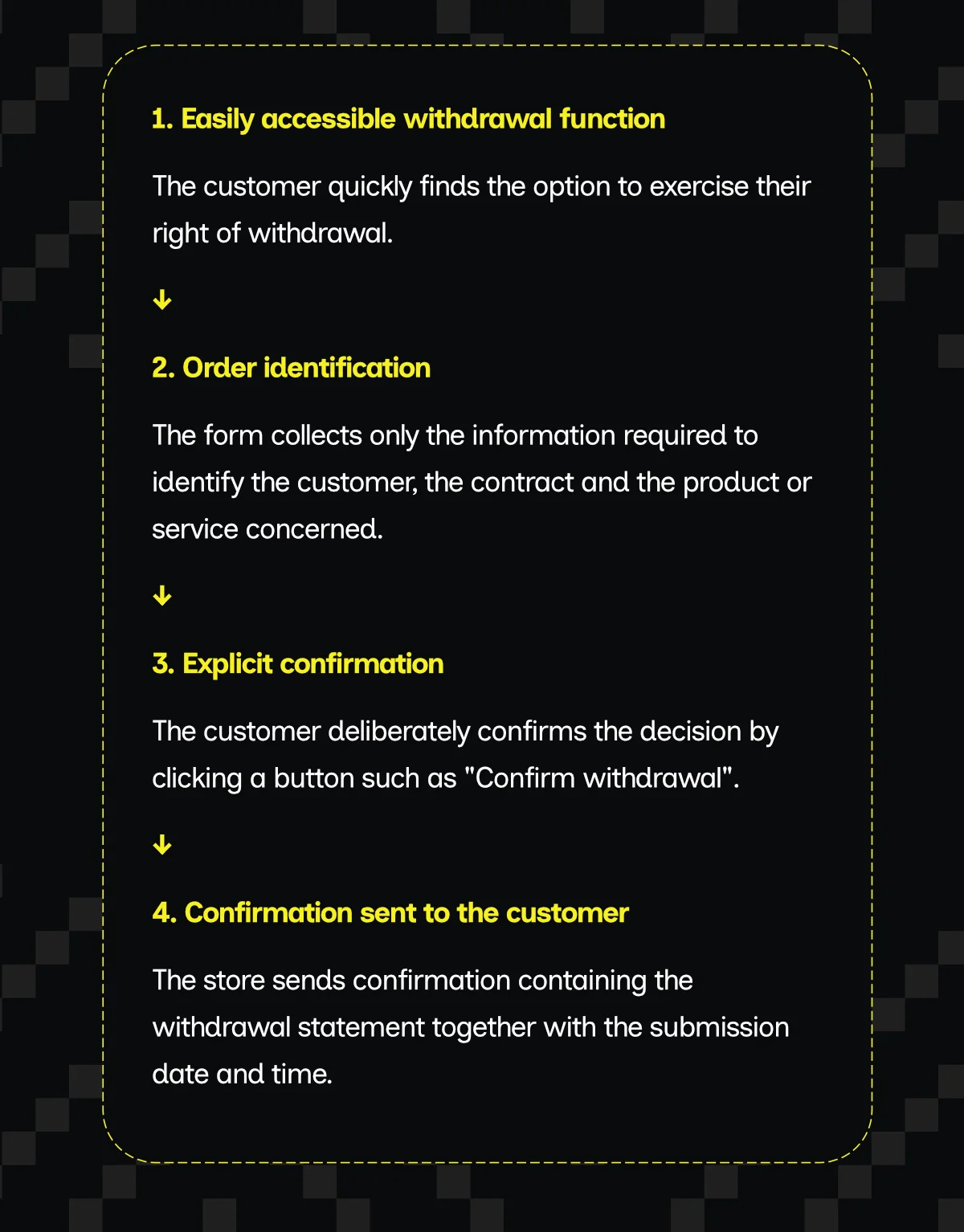
How Should the Online Withdrawal Process Work?
A compliant withdrawal process should follow a clear and predictable sequence:
How to Prepare an Online Store Selling Across Multiple EU Markets
EU Directive 2023/2673 establishes a common objective across the European Union. However, the specific obligations imposed on businesses are defined by the national legislation adopted by each Member State.
If your online store sells across multiple EU markets, you should verify the requirements applicable in every target country.
Your review should cover:
the date on which the national legislation becomes applicable,
the required wording of labels and customer-facing messages,
the types of contracts covered by the legislation,
confirmation requirements,
local enforcement mechanisms and penalties,
language versions of withdrawal forms,
applicable withdrawal periods and statutory exceptions.
A single global configuration may not be sufficient.
For multi-market e-commerce platforms, separate configurations may be required for individual sales channels, countries or versions of the terms and conditions.
What Should You Do If Your Implementation Is Not Yet Complete?
The first step should be an audit covering legal requirements, the customer journey and the underlying system architecture.
The audit should answer four key questions:
Does the withdrawal function comply with the legal requirements applicable in the markets where the store operates?
Can consumers complete the entire withdrawal process without unnecessary barriers?
Does the platform correctly record withdrawal requests and send the required confirmation?
Is the remainder of the process consistent with the organization's systems and operational procedures?
An audit is particularly valuable if:
implementation has stalled during the integration phase,
the withdrawal form works but does not create a valid case in internal systems,
different sales channels handle withdrawals differently,
confirmation messages are not sent or contain incomplete information,
guest orders are not supported,
status information differs between the e-commerce platform, ERP and WMS,
the team cannot reconstruct the history of a specific withdrawal request.
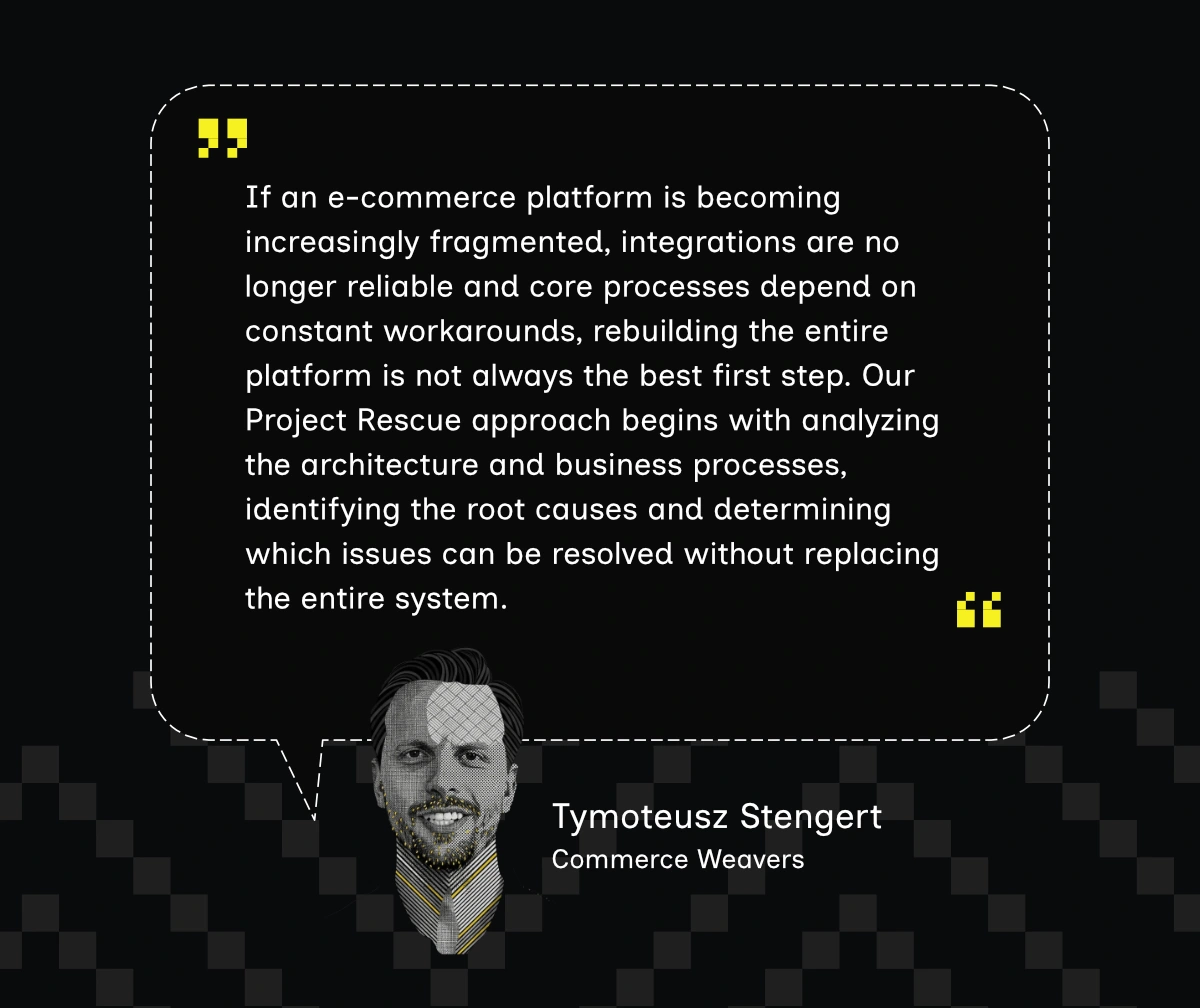
The purpose of the audit is not to recommend replacing the platform by default.
Instead, it should identify the smallest possible scope of changes required to eliminate compliance risks, improve the process and ensure a consistent implementation of the consumer's right of withdrawal.
FAQ – EU Directive 2023/2673 and E-commerce Returns
Does EU Directive 2023/2673 apply to every online store?
No.
The new rules apply to online stores selling products or services directly to consumers (B2C) within the European Union.
If a business sells exclusively to other businesses (B2B), the consumer's right of withdrawal does not apply in the same way.
Is updating the terms and conditions enough?
No.
Updating the terms and conditions is only one part of the compliance process.
The returns workflow, customer communication, information obligations and integrations between the e-commerce platform, internal systems and logistics providers are equally important.
Can compliance be assessed solely by reviewing the storefront?
No.
The withdrawal process extends well beyond the storefront interface.
In practice, businesses should also review internal systems, customer communication, integrations and logistics processes supporting returns.
What should you do if implementation has already started but is not yet complete?
The best starting point is an audit of the existing process.
An audit helps identify which elements have already been implemented, where the highest compliance risks remain and what changes are required to achieve compliance without restarting the project from scratch.