This is why many companies look at Sylius-based solutions and a framework-based approach to e-commerce.
Not because Sylius is fashionable. For many organizations, its greatest value lies in stability and flexibility. It provides a foundation for building systems around a specific sales model, instead of simply adding more features from a ready-made box.
This is where an important question appears: what should you actually expect from a Sylius e-commerce agency? The difference between a team that “knows the framework” and a partner that understands architecture, B2B processes, enterprise integrations, testability and platform scaling is significant.
Why Does Sylius Work So Well in E-commerce?
In modern e-commerce, the biggest challenge is not the storefront frontend. The real complexity sits deeper: in the data model, integrations, pricing, business logic, order workflows, data synchronization and operational processes.
This is especially visible in B2B e-commerce projects, where the platform must handle individual commercial terms, buyer roles, credit limits, multi-level approval processes, ERP, PIM, WMS or OMS integrations and non-standard logistics workflows. This type of system rarely works well if its architecture has been built only around a standard cart and checkout.
Sylius provides an advantage precisely because it does not lock the team into one rigid operating model. It allows the application to be built around the business domain: products, customers, orders, price lists, stock levels, commercial agreements or approval processes. As a result, the platform can evolve with the organization instead of forcing compromises after only a few months of development.
In practice, everyday development fundamentals also matter: dependency injection, a clear service structure, events, workflows, security components, validation, forms, queues and testing. Sylius makes it easier to build systems that can be maintained, refactored and extended without descending into chaos after every larger release.
SaaS, All-in-One Monolith or Sylius? How to Think About Architecture Choice
Not every company needs a custom platform based on Sylius. A good technology agency should be able to say this directly. If the project is simple, the processes are standard and the team needs a fast start, a SaaS solution or an all-in-one system may be the more reasonable choice.
Sylius delivers value where the system needs to adapt to the business, not the other way around. This applies especially to B2B companies, marketplaces, complex pricing models, enterprise integrations and projects where e-commerce is part of a broader operational ecosystem.
| Approach |
When it makes sense |
Main limitation |
| SaaS e-commerce |
Fast start, standard sales process, limited customization scope |
Less control over business logic and integrations |
| All-in-one monolith |
When the company needs many out-of-the-box features and accepts higher complexity |
Harder customization and higher maintenance overhead |
| Sylius / custom commerce framework |
When B2B processes, integrations and business logic are non-standard |
Requires an experienced team and deliberate architecture |
A Sylius E-commerce Agency Is Not Just About Store Development
In many projects, the biggest challenge today is not simply “building the platform.” The harder part is maintaining predictable development afterwards.
That is why a good Sylius e-commerce agency should understand not only code, but also e-commerce system architecture, operational processes, enterprise integrations, the consequences of technology decisions and the impact of architecture on the future cost of platform development.
The experience of a technology partner should cover not only feature development, but also architecture design, integration stabilization, technical debt management, regression testing, platform scaling and recovering control over projects that have stopped evolving predictably.
An agency that can deliver tasks but does not understand architectural consequences may accelerate the project in the short term while making future development harder. In B2B e-commerce, this is especially risky because mistakes do not end with worse UX. They can affect pricing, orders, invoicing, product availability and the work of operational teams. That is a direct path to losing customers.
Find out what to do when your deployment is deadlocked.
Why Do More E-commerce Projects Start with a Proof of Concept?
A few years ago, many companies started full platform development almost immediately. Today, the first stage is increasingly a Proof of Concept.
The reason is simple.
In modern e-commerce, the greatest risk is often not writing the code itself, but making incorrect assumptions about architecture, integrations or business processes. A POC allows teams to verify these elements earlier: before the project enters its most expensive phase, before the architecture starts generating technical debt and before the organization invests a large budget in a direction that may later require rebuilding.
This is especially important in B2B e-commerce projects, where system complexity grows very quickly. A Proof of Concept can verify whether the selected pricing model makes sense, whether the ERP integration is stable, whether the order workflow can be represented in the system and whether the architecture will allow the platform to evolve in later stages.
For a decision-maker, a POC provides something very concrete: the ability to make the next decision based on a working part of the system, not only on presentations, estimates and assumptions. A careful validation of capabilities protects the company from costly technical debt.
Discover when to kick off with a PoC vs an MVP.
And since we are on that topic...
Are you looking for validation that your project has a solid business case?
We will build your MVP in just three months! We will help you select an architecture capable of handling global sales.
Contact us ↗
Technical Debt in E-commerce Grows Faster Than Most Companies Expect
One of the biggest problems in modern e-commerce platforms is technical debt. It accumulates gradually, often as the result of decisions that seemed justified at the time.
The project starts quickly, the roadmap is ambitious, and new features are delivered under time pressure. Integrations are built “quickly,” tests are pushed into the background, and some architectural decisions are postponed “until later.” For a while, the system works correctly and the business sees progress.
The problem begins when the company wants to scale the platform, expand B2B processes or implement more complex integrations. Suddenly, every change takes weeks, releases introduce regressions, and the team starts avoiding changes in certain parts of the codebase.
That is the moment when technical debt starts to have a real business impact.
An experienced Sylius e-commerce agency should be able not only to build new features, but also to manage technical debt consciously and anticipate the consequences of decisions made at earlier stages of the project. Sometimes this means refactoring a selected module. Sometimes it means stabilizing integrations. Sometimes it means introducing regression tests. And sometimes it means giving an honest recommendation that continuing to patch the current architecture no longer makes economic sense.
Why Are Tests Critical in E-commerce?
In many organizations, tests are still treated as a technical add-on to development. In practice, in more complex e-commerce projects, tests are one of the foundations of predictable platform evolution.
If a company serves different customer groups, individual commercial terms and complex purchasing processes, every change in the system may have consequences in several places at once.
A lack of tests increases the risk of production issues. A new promotion may affect prices for a selected customer group. A checkout change may disrupt an ERP integration. A payment module update may cause problems in the wholesale order process.
That is why a good Sylius e-commerce agency should design the platform in a testable way. This means not only writing tests, but also creating a code architecture that allows business logic to be isolated, regressions to be controlled and the system to evolve safely over time.
How to Recognize a Good Sylius E-commerce Agency
A professional software house does not start the conversation with a list of features. Instead, it begins by understanding business processes, architectural risks, integration dependencies, the operating model and how the platform is expected to evolve over the next year or two.
This matters because most e-commerce challenges are not caused by the technology itself. They are usually the result of decisions made too early or without fully understanding their architectural consequences.
In practice, there are several things you should expect from a technology partner.
First, they should ask challenging questions about processes, data and integrations before proposing a solution.
Second, they should understand that feature development without architectural control can increase the long-term cost of maintaining the platform.
Third, they should be able to say no when the project scope is unclear or when the technology does not fit the problem.
The selected technology partner must be able to work with both new projects and existing platforms. This means the ability to audit code, diagnose technical debt, refactor existing solutions, take over projects from previous vendors and design a further roadmap in a way that does not paralyze current sales.
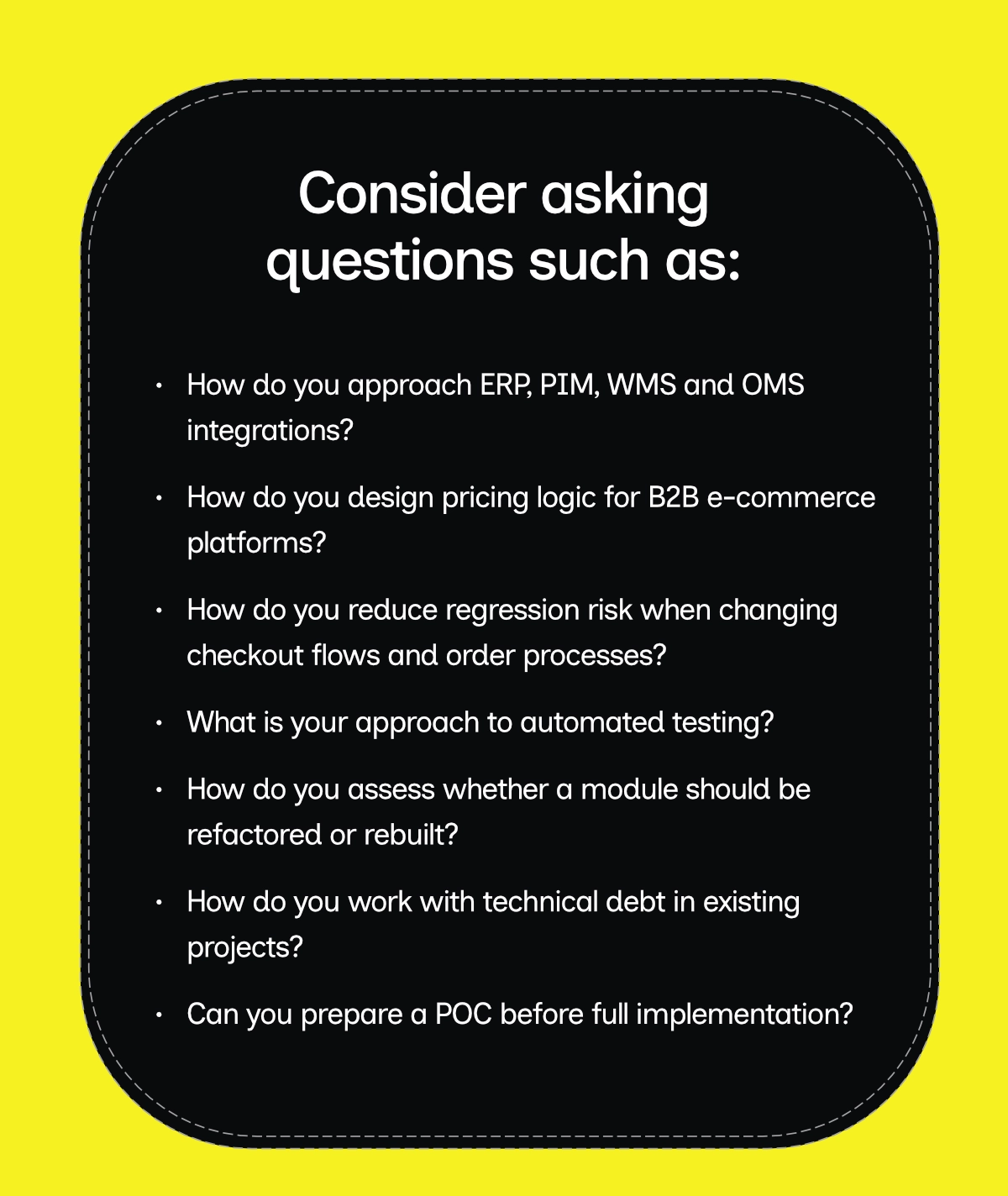
Questions Worth Asking Before Working with a Sylius Agency
If a company is considering cooperation with a software house, it is worth checking not only the portfolio, but also how the team thinks. Good questions quickly reveal whether you are speaking to a task executor or to a partner responsible for architecture and platform evolution.
The answers often reveal far more than a declaration of Sylius expertise. They show whether the team understands e-commerce as a business system or only as an application to implement.
B2B E-commerce Needs Technology Partners Today
In more complex e-commerce projects, development is very rarely the biggest challenge. The harder part is combining architecture, integrations, business processes, scalability, engineering quality and long-term platform maintenance.
That is why companies are increasingly looking not only for a software house, but for a technology partner that understands the consequences of architectural decisions and can think about the platform as a system supporting a real business.
This is the direction modern e-commerce is moving towards: solutions built on Sylius, modular frameworks and a more deliberate approach to architecture.
FAQ – Sylius E-commerce Agency
Why is Sylius a good fit for e-commerce?
Sylius provides strong architectural flexibility, supports integrations well and enables teams to build platforms tailored to complex business processes.
When does SaaS stop being enough for B2B e-commerce?
Typically when the business requires custom pricing, advanced integrations, B2B workflows and greater control over platform architecture.
Is Sylius a good choice for B2B e-commerce?
Yes. Sylius is well suited to B2B projects that require flexible architecture, ERP integrations and more complex purchasing processes.
What should a good Sylius e-commerce agency understand?
Not only store development, but also system architecture, integrations, technical debt, business processes and platform scaling.
Why do e-commerce projects end up in project rescue?
The most common reasons include growing technical debt, architectural issues, lack of tests and uncontrolled integration development.
Is Sylius always the best choice for e-commerce?
No. Sylius delivers the greatest value in projects that require flexibility, custom business logic, integrations and long-term architectural control. For simple stores, SaaS may be a better choice.