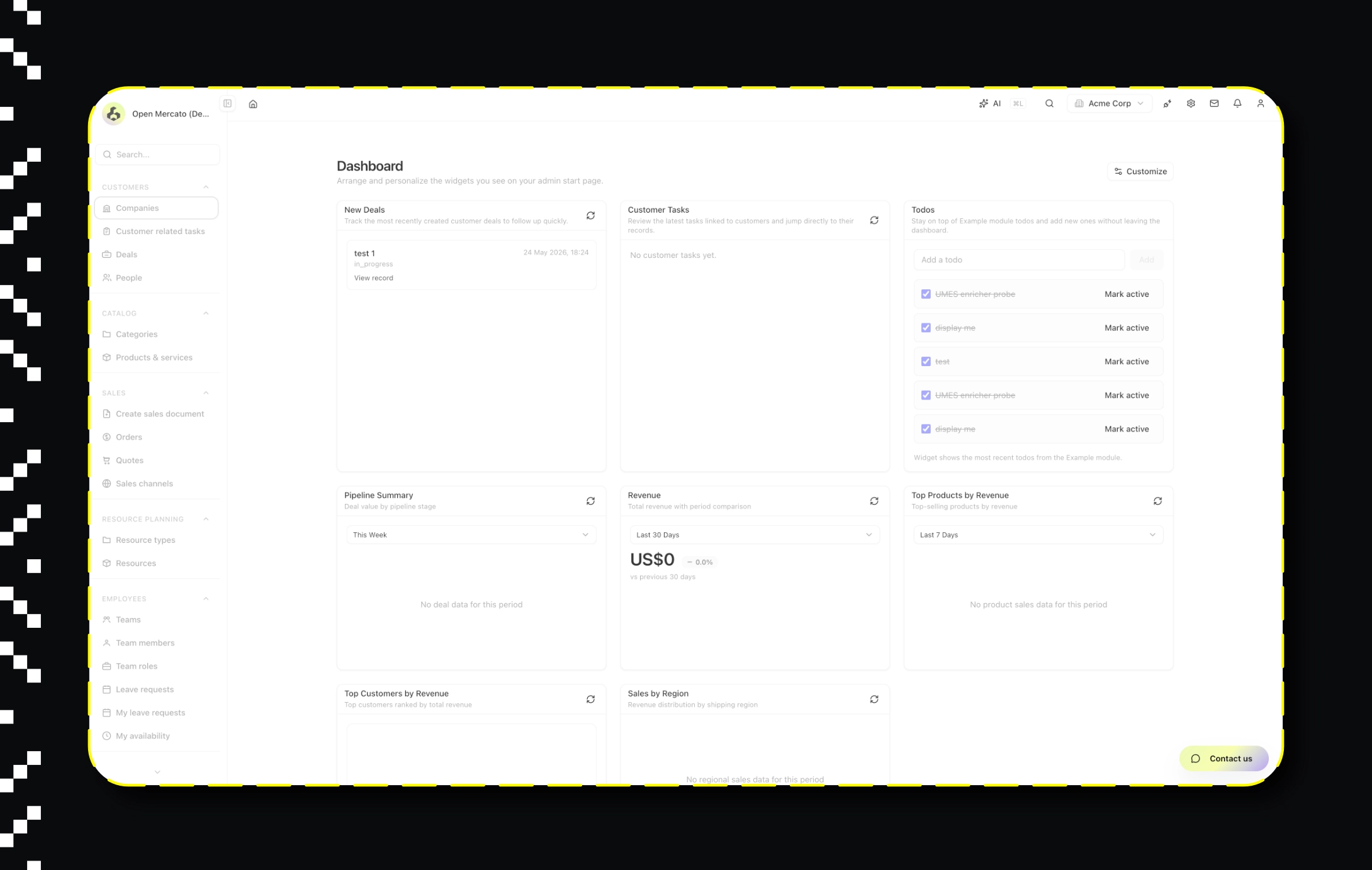
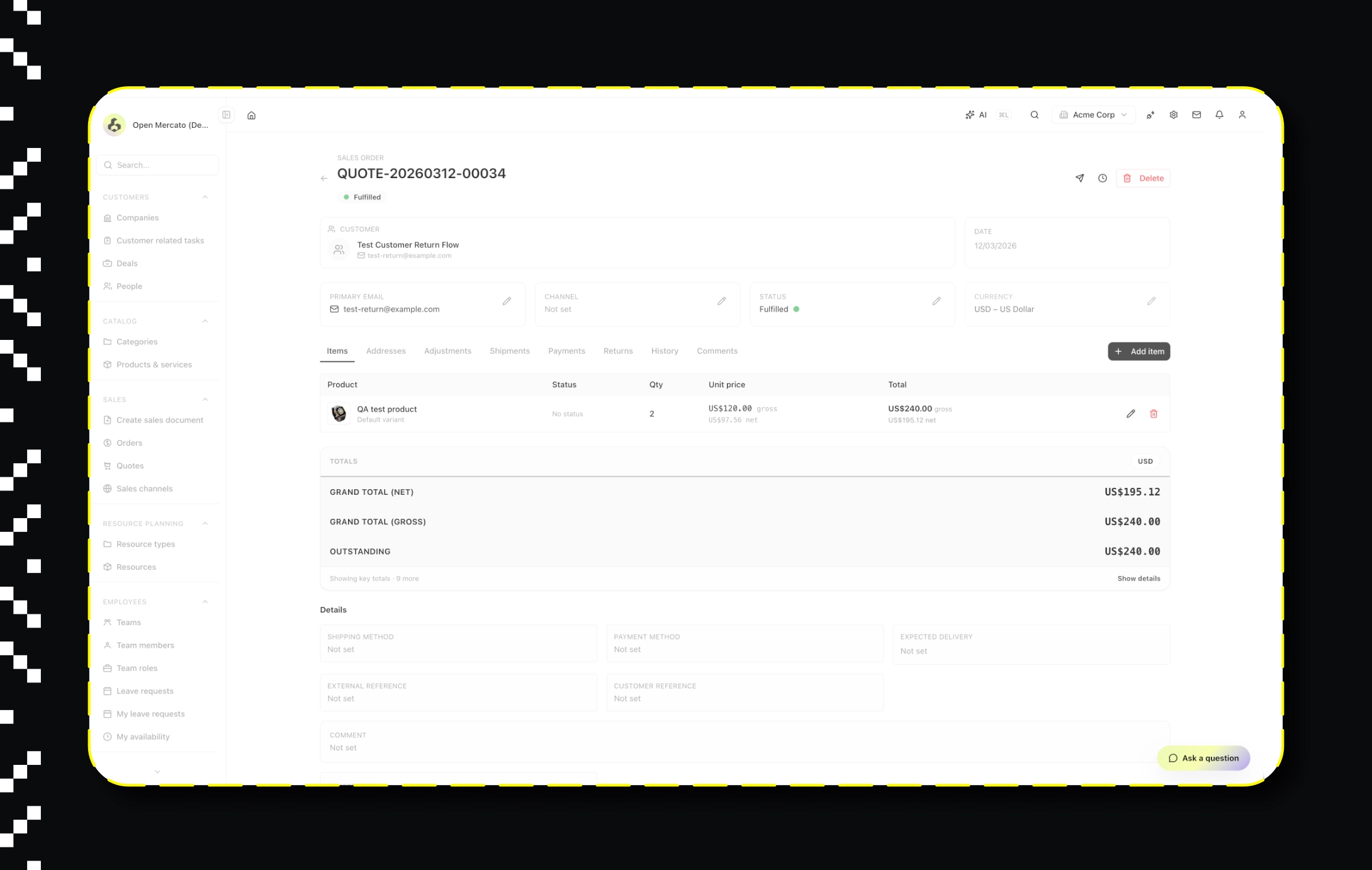
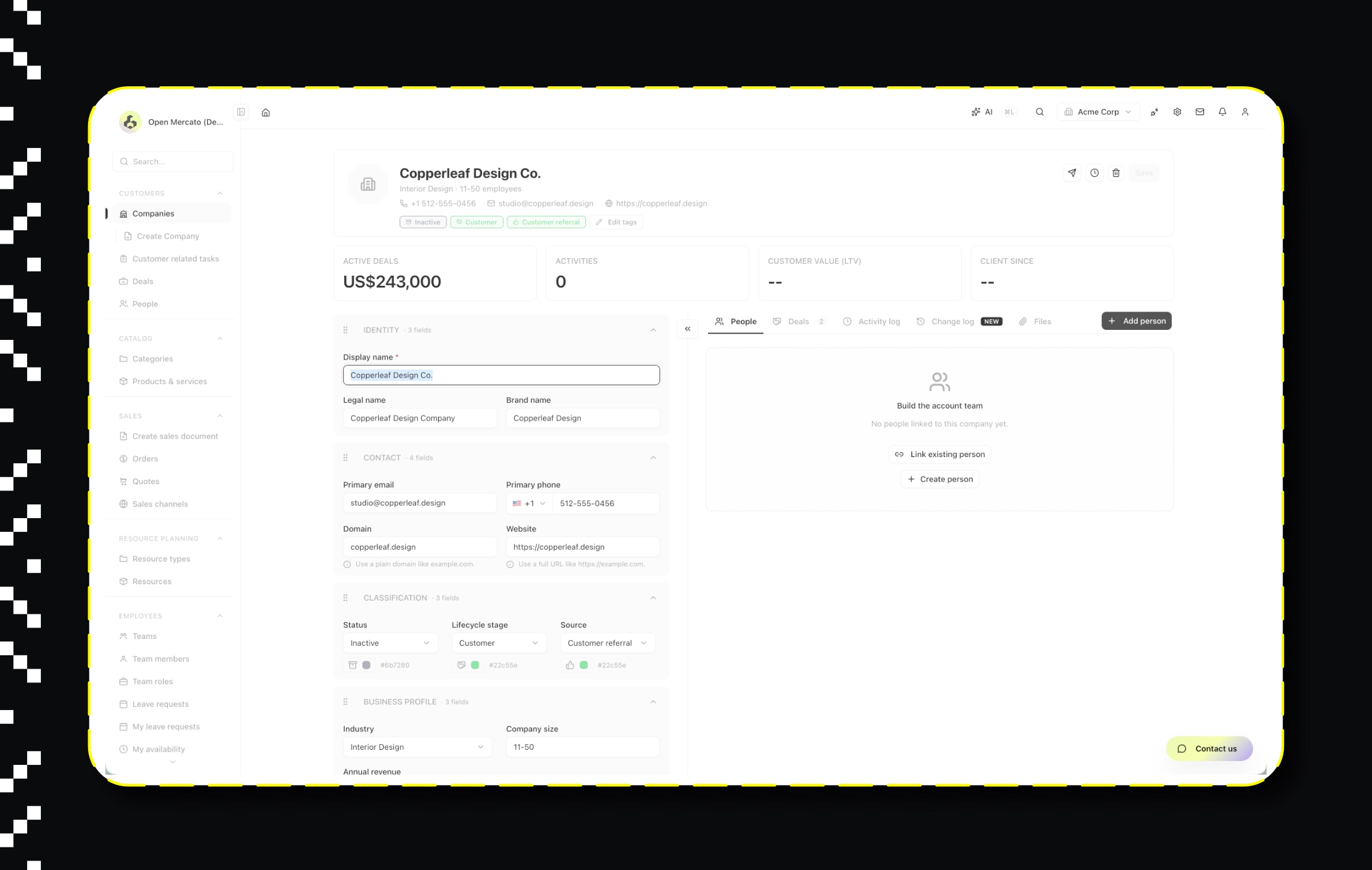
This is exactly where Open Mercato disrupts traditional paradigms. It represents a prime example of an AI-Engineering Foundation Framework – a category of software scaffolding specifically engineered so that collaboration with autonomous AI agents and AI-assisted development tools remains deterministic, highly structured, and predictable. By radically driving down foundational setup overhead, this paradigm shifts the economic calculation back in favor of tailor-made enterprise software.
Why Building Enterprise Applications from Scratch is Becoming Obsolete
Initiating the development of most custom business applications exposes teams to an identical, repetitive matrix of structural challenges. Whether an organization is building a CRM, an ERP, a specialized logistics kernel, or the complex operational control plane of a B2B commerce engine, engineers must repeatedly construct a baseline architecture:
Historically, a massive share of the project budget and timeline was consumed by these internal, non-functional platform requirements – elements invisible to the end user but paramount to engineering an unyielding system core.
Simultaneously, enterprise scale-ups have increasingly hit the functional ceilings of monolithic, multi-tenant SaaS products. While turnkey applications perform adequately for basic operational flows, friction escalates when a company relies on non-standard fulfillment logic, proprietary pricing equations, or deep legacy integrations. In these scenarios, teams often end up managing a fragmented patchwork of disconnected SaaS tools that introduces severe, ongoing systemic complexity.
Relying solely on AI code agents or unguided "vibe coding" does not automatically solve this architectural dilemma. Tools like Cursor, GitHub Copilot, and Claude accelerate raw syntax generation but do not establish system architecture. They do not dictate where functional responsibilities should reside, how boundary contexts between internal modules must be structured, or how code quality can be preserved across an enterprise engineering team over time. Furthermore, pure low-code or AI prototyping sandboxes are architecturally unsuited for building long-term, maintainable enterprise software backends.
This makes framework conventions that provide a strict architectural blueprint – rather than just unstructured code blocks – absolutely paramount.
Read about our participation in the Open Mercato Hackathon.
What is Open Mercato?
Open Mercato is a modular, open-source framework distributed under the permissive MIT license, designed to construct bespoke business backends (CRM, ERP, WMS, OMS) and foundational corporate operating systems.
The repository is positioned specifically as an AI-Engineering Foundation Framework, meaning it acts as an optimized runtime environment for development workflows augmented by autonomous AI agents. This designation does not mean Open Mercato generates software out of thin air via heuristic prompts. Instead, its function is to provide a highly uniform, convention-based architectural baseline where human engineers and AI code agents operate within identical structural constraints.
The explicit goal is to eliminate the empty-repository starting point, launching projects from an unyielding foundational stack that contains the core plumbing required by virtually any enterprise software backend.
The framework is developed with the corporate backing of Catch The Tornado, with Commerce Weavers operating as a certified agency partner within the Open Mercato ecosystem.
Deep Architectural Components of Open Mercato
Rather than delivering disconnected functional features, Open Mercato provides a comprehensive suite of tightly integrated architectural components:
modular architecture, which consists of:
auto-discovery of frontend modules, API, CLI, i18n and DB entities,
modular monolith based on Next.js and TypeScript,
MikroORM and PostgreSQL with migrations per module,
dependency injection implemented via Awilix,
data validation using zod,
multi-tenancy by default based on tenant_id and organization_id on every entity, with support for hierarchical organizations,
RBAC with feature flags defined at the role and user level, including organizational scope,
workflow engine operating locally or in a Redis-backed model,
event subscribers,
Meilisearch and PGVector, supporting full-text, keyword and semantic search,
field-level encryption per tenant using Vault/KMS and AES-GCM,
deterministic hashes for lookups,
audit log,
AI assistants embedded in the administration panel, with "human in the loop" before every write operation,
Overlays mechanism, which allows extending the core without modifying the core and without the need to maintain a fork.
This structural separation ensures that Open Mercato does not attempt to serve as a generic, pre-configured ERP out of the box; instead, it establishes an opinionated, highly reliable structural template for enterprise systems.
How Open Mercato Approaches AI and Agentic Engineering
The defining characteristic of Open Mercato is its structural alignment with AI-assisted development paradigms.
The framework is designed under the assumption that Large Language Models (LLMs) and autonomous AI coding agents are permanent actors within the software engineering lifecycle. Instead of treating AI as an external utility, Open Mercato exposes a codebase structure where agent-generated logic drops into predictable architectural slots.
This predictable integration relies on several core pillars:
Strict file-system and class-naming conventions
Rigid modular decoupling boundaries
Spec-first engineering processes
Native administrative AI assistant frameworks
Tiered AGENTS.md context files combined with targeted context routing
Furthermore, the framework enforces a strict approval cards system. Any autonomous agent execution that targets data persistence or triggers operational mutations must be rendered as an explicit card in the interface, requiring a human user to verify and approve the transaction (Human-in-the-Loop pattern).
The multi-tiered AGENTS.md protocol serves as an automated onboarding guide for LLMs. It defines the exact directory layouts, structural interfaces, coding standards, and architectural constraints that an external agent must respect when appending or refactoring features within that module boundary.
Complementing this is the framework's spec-first development approach. Every substantial architectural alteration begins by drafting detailed markdown specifications within the .ai/specs/ directory. These documents act as an unambiguous, single source of truth that can be accurately parsed and processed by human architects and autonomous AI tools alike.
This structural discipline targets the primary bottleneck of modern software development: the challenge isn't the raw speed of code generation, but rather preserving design integrity, avoiding architectural drift, and preventing technical debt within multi-engineer teams managing complex enterprise software.
Real-World Impact on the Engineering Lifecycle
The fundamental value proposition of Open Mercato is not merely writing syntax faster. It lies in compressing the time-to-market required to reach the testing phase of core business logic.
Engineering teams no longer spend valuable sprints setting up database multi-tenancy filters, crafting authorization hierarchies, or wiring routing boilerplate. Instead, they immediately focus on building the proprietary domain algorithms and custom workflows that differentiate the business from its competitors.
Open Mercato establishes high standardization across the entire system layout. User personas, state machines, module boundaries, organizational isolation layers, and asynchronous event streams are bound to explicit architectural patterns. This eliminates ad-hoc, short-sighted design deviations during crunched deadlines and simplifies developer onboarding.
In enterprise environments, this translates directly to:
Accelerating new feature deployment velocities
Enhancing the reliability of sprint estimates
Mitigating structural architectural entropy
Drastically shortening the project's time-to-value
Ideal Use Cases for Open Mercato
Open Mercato is not a silver bullet for every software project. It provides the highest return on investment for organizations facing highly complex business logic that require absolute control over their operational data models.
The framework is optimized for engineering:
Custom CRM architectures with proprietary scoring logic
Specialized Enterprise Resource Planning (ERP) systems
Complex Warehouse Management Systems (WMS)
Order Management Systems (OMS) with multi-node logistics routing
High-volume B2B e-commerce operational backends
Configurator, Price, Quote (CPQ) computation platforms
Advanced, multi-tier partner self-service portals
It is equally effective when an enterprise needs to consolidate an unmanageable constellation of disconnected legacy applications into a single, unified codebase, or when a high-growth scale-up begins to buckle under the operational maintenance overhead of external SaaS integrations.
When Open Mercato is Not the Optimal Choice
It is vital to state clearly that Open Mercato is an early-stage, rapidly iterating framework. If your enterprise requires a mature, decades-old software ecosystem backed by a massive community and a slow, highly predictable multi-year release roadmap, you should evaluate alternative legacy platforms.
Furthermore, Open Mercato is not a turnkey, click-to-install software solution. It is a highly technical developer framework that requires a mature understanding of software architecture and a team ready to contribute to its evolution. It does not compete with legacy software based on an out-of-the-box feature checklist; its competitive advantage is its absolute malleability and its capacity to precisely mirror complex internal corporate logic.
While Open Mercato is optimized for AI-first development, its implementation still requires professional software engineers. Organizations must realistically model their Total Cost of Ownership (TCO), accounting for custom integration development, infrastructure maintenance, custom overlay building, and ongoing architectural oversight.
Finally, it is not an appropriate solution to serve as a standard B2C storefront or consumer-facing digital commerce platform. For standard digital storefront logic, mature, commerce-dedicated frameworks like Sylius remain the industry standard choice. In those enterprise architectures, Open Mercato is highly effective when deployed in a complementary role as the underlying operational ERP or logistics master system behind the commerce platform.
Navigating an Early-Stage Framework Reality
The rapid evolution of Open Mercato means developers gain access to fast iteration cycles, but must also navigate the natural characteristics of a young technology stack.
To address this transparently, the core maintainers ship explicit ISSUE_LOG.md and UPGRADE_NOTES.md logs directly inside the framework repositories. The core engineering team communicates codebase changes, known bottlenecks, and strategic roadmap adjustments openly.
While conservative enterprise teams might view this level of fluidity as an operational hurdle, agile organizations recognize it as an asset. Early adopters gain a unique opportunity to directly steer the evolution of the framework, maintain a close feedback loop with the core architects, and ensure the platform's strategic development aligns perfectly with their real-world enterprise requirements.
Can Open Mercato Reshape Enterprise Software Engineering?
The most compelling aspect of Open Mercato is its refusal to compete directly with fixed SaaS applications or standard, low-level programming toolkits. Instead, its ambition is to carve out an entirely new operational middle layer: bridging the gap between high-risk custom development from scratch and the restrictive limitations of off-the-shelf software packages.
When coupled with autonomous AI code agents and modern Agentic Engineering workflows, this convention-driven model offers an exceptionally compelling path forward.
As the physical writing of baseline boilerplate code consumes fewer engineering hours, the strategic value of software development shifts entirely toward:
High-level software architecture decisions
Rigorous business process modeling
Structured corporate data design
System-wide code maintainability across distributed teams
Uncovering and mapping the precise operational needs of the business
This is exactly the high-value layer where Open Mercato establishes its core technical advantage.
Looking for support with an Open Mercato implementation? We can help. Get in touch and let's talk.
FAQ – Open Mercato
What is Open Mercato?
Open Mercato is an open-source, MIT-licensed framework engineered for building custom enterprise applications such as CRMs, ERPs, WMS architectures, and complex B2B backend systems.
Is Open Mercato a pre-configured, turnkey ERP application?
No. The framework delivers a highly structured architectural baseline and core operational modules, but it requires developers to model and implement the specific business logic of the organization. title: We're Building the Open Mercato Financial Module. Starting with the Chart of Accounts and General Ledger.
What core technologies power the Open Mercato stack?
The framework is built natively on the Next.js App Router, TypeScript, MikroORM, PostgreSQL, the Awilix dependency injection container, and Zod validation schemas.
How does Open Mercato leverage Artificial Intelligence?
The framework is structurally optimized for AI-assisted development and Agentic Engineering by utilizing strict folder conventions and AGENTS.md blueprints that keep AI code agents operating safely within predictable architectural boundaries.
Which projects gain the highest return from using Open Mercato?
Highly customized business backends, multi-tier corporate networks, and specialized logistics or B2B infrastructure platforms that have outgrown the constraints of standard SaaS products.
Is Open Mercato a fully stabilized, legacy framework?
No. Open Mercato is a dynamic, early-stage framework that is iterating rapidly. Decision-makers should evaluate it with an awareness of the benefits and maintenance realities of an early-stage ecosystem.