In practice, companies need to answer three questions:
Which B2B processes are actually worth automating?
Where are traditional business rules sufficient, and where does AI make sense?
Which decisions and activities should remain in human hands?
These questions are particularly important in B2B e-commerce, where sales processes may involve customer-specific pricing, limits, user roles, approval workflows, integrations with multiple systems and custom order fulfillment rules.
What Is B2B Process Automation?
B2B process automation involves assigning repetitive, standardized tasks to systems that can execute them without manual intervention or with limited human involvement.
In B2B e-commerce, this might include automatically:
Forwarding orders for further processing and fulfillment.
Applying the correct prices and commercial terms.
Synchronizing product information and availability.
Sending notifications when order statuses change.
Making documents available to customers.
Triggering specific approval workflows.
Exchanging data between the e-commerce platform and other business systems.
The goal isn't automation for its own sake. It's to reduce manual work, minimize errors, speed up processes and enable organizations to handle higher sales volumes without a proportional increase in operating costs.
Automation vs. AI: What's the Difference?
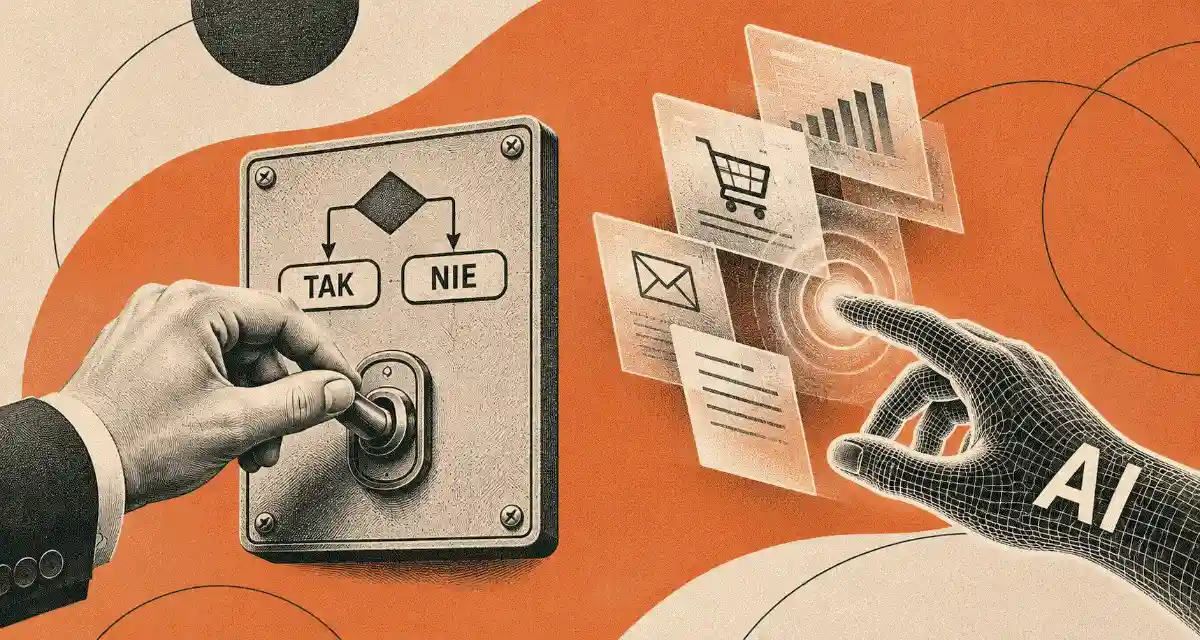
This distinction is becoming increasingly important. Traditional automation executes processes according to predefined rules. AI is particularly useful when a system needs to interpret information, recognize patterns, work with unstructured data or support human decision-making.
Consider a simple example.
If a customer is entitled to an 8% discount after meeting specific contractual conditions, there's no need for AI. The system can apply a clear business rule. Now imagine a sales representative who wants to identify products worth recommending during their next conversation with a customer, based on purchase history, customer behavior and other available data. That's where artificial intelligence may be useful.
The same distinction applies to orders submitted by email. Traditional automation can handle the subsequent steps according to a defined workflow. AI can help earlier in the process by interpreting an unstructured email or document and extracting the information needed for further processing.
A useful rule of thumb is:
| Process characteristics |
Approach worth considering |
| Clear conditions and an unambiguous outcome |
Traditional automation |
| Repeatable workflows between systems |
Traditional automation |
| Interpreting text or documents |
AI + automation |
| Searching based on meaning and context |
AI |
| Recommendations based on multiple data sources |
AI-assisted decision-making |
| Decisions with significant business consequences |
Business rules, validation and appropriate human oversight |
Understand the Process Before Automating It
One of the biggest mistakes companies make is starting with the technology. A business identifies a problem, chooses a new tool or plans an AI implementation, and only then starts asking what the process should actually look like.
The result can be a highly efficient automation of a process that shouldn't have been maintained in its existing form in the first place.
Take an order that requires several manual approvals. Before designing an automated workflow, you need to understand why those approvals exist and when they're genuinely necessary.
The same principle applies to AI. A model shouldn't be used as a workaround for inconsistent data, unclear responsibilities or a poorly designed process.
Before introducing automation, it's worth asking:
Where are the process bottlenecks?
At which stages do errors occur most frequently?
Which tasks are performed manually, and why?
Which activities can be described using clear business rules?
Where does the process require interpreting information or evaluating context?
Which decisions require human expertise or accountability?
What business outcome should automation deliver?
Only after answering these questions can you determine what to automate, where AI might help and where people should remain involved.
At Commerce Weavers, we often find these answers during a Discovery workshop. Before designing a solution, we want to understand the process and identify its actual bottlenecks.
Which B2B E-commerce Processes Are Worth Automating?
Not every B2B process offers the same potential for automation. The best candidates are usually tasks performed frequently, repeated in a predictable way, requiring substantial manual effort or becoming increasingly prone to errors as operations scale.
In practice, it's worth examining processes related to order management, pricing and commercial terms, customer service, product catalogs, documents and the day-to-day work of sales teams.
The right technological approach will vary across these areas. Sometimes traditional rule-based automation is enough. In other cases, AI can provide additional value. Some processes benefit most from combining both approaches.
1. B2B Order Management Automation
Order management is one of the most natural areas for automation in B2B e-commerce.
When a customer places an order through a platform, the system can automatically:
Verify basic transaction conditions.
Trigger the appropriate approval workflow.
Forward order data to other systems.
Update the order status.
Send relevant notifications.
Pass the information required for fulfillment and shipping.
AI usually isn't necessary for this process. The conditions are known, the data follows a defined structure, and the outcome should be predictable.
But what about orders submitted by email or as separate documents? That's where things become more interesting.
In many B2B organizations, customers still submit orders through emails, spreadsheets or documents generated by their own systems. When an employee has to read each document, identify products and quantities, and manually enter the information into another system, AI becomes worth considering.
A model can help:
Identify the type of document.
Extract the required information.
Map the extracted data to the structure expected by the system.
Flag items that require additional verification.
AI can help interpret an unstructured order, but deterministic business logic should still control the parts of the process that require an unambiguous outcome.
2. Pricing, Discounts and Customer-Specific Commercial Terms
In B2B e-commerce, a product doesn't necessarily have one price displayed to every customer. Pricing may depend on contracts, customer segments, order volumes, product groups, currencies, markets or other agreed commercial terms.
When the rules are known, traditional automation is the natural choice. The system can apply the appropriate price list, discount or conditions for the logged-in customer. There's no reason for an AI model to decide whether a customer qualifies for a discount explicitly defined in their contract.
AI can, however, support analytical tasks. For example, it can help sales teams identify patterns in sales data, prepare information ahead of negotiations or detect anomalies that deserve closer examination.
The distinction matters: commercial rules should be enforced by the system, while AI can provide additional context for decisions that need to be made.
3. B2B Customer Self-Service and Customer Service Automation
One of the most valuable outcomes of automation is allowing customers to complete tasks that previously required contacting a sales representative or customer service team.
A B2B platform can provide self-service access to:
Order statuses.
Purchase history.
Invoices and other documents.
Product availability.
Customer-specific prices.
Reordering.
User and permission management.
Delivery information.
AI can add another layer of convenience. Instead of requiring users to navigate to a specific section of the platform, an AI-powered interface can let them ask a question and help them find the relevant information, document or instructions.
4. Product Catalog and Product Data Automation
The larger the catalog, the more markets a business serves and the more technical its product range, the more work is involved in maintaining accurate product data.
Traditional automation can handle data exchange between a Product Information Management (PIM) system, the e-commerce platform and other business systems.
AI can support tasks involving the content and structure of product data, such as:
Classifying products.
Suggesting product categories.
Supporting product attribute mapping.
Drafting product descriptions.
Assisting with translations.
Identifying missing or inconsistent information.
That doesn't mean AI should be allowed to publish product information without oversight. When dealing with technical specifications, regulatory information or data that affects whether a customer selects the right product, an error can have much more serious consequences than an imperfect marketing description.
The level of automated validation and human oversight should therefore reflect the type of data and the risks associated with getting it wrong.
5. Product Search in B2B E-commerce
Product search is a good example of an area where traditional mechanisms and AI can complement each other.
In many B2B purchasing scenarios, users already know the SKU, manufacturer's part number or exact product name. In those cases, fast, conventional search may be all they need.
The challenge arises when customers know what they need but don't know which product to look for. They may be searching for an alternative to an existing product, describing an application in their own words or using terminology that differs from the manufacturer's.
In these situations, semantic search and AI-powered mechanisms can help interpret user intent more accurately.
The choice of technology should ultimately reflect how customers actually search for products.
6. B2B Sales Automation and Sales Team Support
Automating B2B sales doesn't necessarily mean moving the entire sales process onto an e-commerce platform.
In many organizations, sales representatives continue to play a crucial role, particularly when working with major accounts, negotiating agreements, selling complex products or managing customer-specific commercial relationships.
Technology can, however, reduce the time they spend preparing for these activities.
Traditional automation can transfer information between systems, create tasks when specific events occur and trigger predefined workflows.
AI can support B2B sales representatives by:
Summarizing a customer's purchase and relationship history.
Gathering key information before a customer meeting.
Finding relevant data across multiple sources.
Preparing draft responses.
Suggesting products that may be relevant in a particular context.
Highlighting unusual changes in purchasing behavior.
7. Document Processing and Information Flow
B2B operations still rely heavily on documents, including quotations, specifications, purchase orders, invoices, contracts and technical materials.
When documents follow a consistent structure and the system knows exactly where to find the required information, traditional automation is often sufficient.
AI becomes more useful when documents:
Come from multiple sources.
Use different formats.
Contain unstructured text.
Require classification.
Need specific information to be extracted.
A model can help prepare data for subsequent processing, but the consequences of potential errors must still be considered.
Automatically identifying a document's category carries a different level of risk from using AI to interpret contractual provisions that affect the financial terms of a transaction.
How to Choose Which B2B Processes to Automate
The greatest automation potential isn't always found in the most complex processes. Automating a simple task performed hundreds of times a day can often deliver more value than automating a sophisticated process that runs only a few times a month.
Before starting development, it's worth evaluating each process against five criteria:
| Factor |
Question to ask |
What to evaluate |
| Frequency |
How often is the process performed? |
The more frequently the same task is performed manually, the greater its potential for automation may be. |
| Operational cost |
How much time and effort does the process require? |
Consider not only the cost of a single operation, but also its total volume over a month or year. |
| Cost and risk of errors |
What happens if the process is performed incorrectly? |
Account for both the cost of manual corrections and business consequences, such as incorrect pricing, order errors, delays or damage to customer relationships. |
| Standardization potential |
Does the process follow a repeatable pattern? |
The more predictable the process, the easier it is to automate. Where there are many exceptions, automating only part of the process may be more appropriate. |
| Nature of data and decisions |
Does the task require executing a rule or interpreting information? |
Clear rules generally point toward traditional automation. Interpreting text, documents or context may justify using AI. |
B2B E-commerce Automation with Sylius
In complex B2B projects, automation capabilities also depend on the platform's architecture and how it interacts with the rest of the technology environment. Sylius supports the development of custom business logic and integrations with the systems an organization already uses. This is particularly important when sales processes go beyond the standard online store model.
However, that doesn't mean every automated process should be implemented directly within Sylius.
Some business logic may belong in an ERP, PIM, CRM, Order Management System (OMS) or another application. More complex architectures may also include a separate layer responsible for process orchestration.
The same principle applies to AI. A model can be one component of the solution, but it needs a clearly defined responsibility, access to the right data and control mechanisms appropriate to the risks involved.
FAQ: B2B Process Automation and AI
Which B2B Processes Are Worth Automating?
Start by examining processes that are frequent, repetitive, time-consuming and prone to errors.
In B2B e-commerce, these may include order processing, data synchronization, applying customer-specific pricing and commercial terms, providing access to documents and certain customer self-service operations.
However, priorities should be determined by potential business value rather than technical feasibility alone.
Where Can AI Be Used in B2B E-commerce?
AI can be particularly useful for interpreting documents and messages, semantic search, working with product data, generating recommendations and helping sales representatives analyze information.
Its greatest potential lies in areas where traditional rules aren't sufficient because the data is unstructured or the task requires interpreting context.
What's the Difference Between Automation and AI?
Traditional automation executes processes according to predefined rules.
AI can support tasks that require interpretation, pattern recognition or generating recommendations.
In practice, the two approaches often complement each other. AI interprets the data, while traditional business logic controls the subsequent steps of the process.
Can AI Fully Automate B2B Sales?
Some processes can achieve very high levels of automation, but full automation shouldn't be the goal in itself.
Complex B2B sales often involve negotiations, individual customer relationships and decisions that require human accountability.
AI and automation can take over some operational tasks and prepare the information needed to support decision-making.
Where Should You Start with B2B Sales Automation?
Start by mapping the process and identifying where the greatest costs, delays or errors occur.
Next, assess how frequently the process is performed, how easily it can be standardized, the consequences of potential errors and the nature of the data involved.
Only then should you decide whether traditional automation, AI or a combination of approaches is the right solution.
How Can You Tell Whether B2B Automation Is Worth the Investment?
Before implementation, establish a baseline and define a measurable goal.
This could mean reducing processing time, decreasing the number of manual operations, minimizing errors or lowering the cost of a particular process.
After implementation, measuring the same indicators will help you evaluate the actual business impact.